Migration, Winged or Storming the Boring Frontier
Software maintenance consumes the majority of engineering lifecycles, trapping developers in a cycle of manual, high-stakes complexity. Autonomous, agentic orchestration layers are turning code from a brittle, depreciating asset into a fluid, self-optimizing substrate — decoupling engineering velocity from human throughput.
01 Maintenance: The Boring Stuff
The title of this essay borrows from Winged Migration (Le Peuple Migrateur, 2001), Jacques Perrin's documentary that follows migratory birds — geese, swans, storks, cranes — across thousands of miles and all seven continents, from northern breeding grounds to warmer equatorial latitudes and back. The birds in Perrin's film make this grueling journey twice a year, season after season, simply to survive. Software, it turns out, is no different: once deployed, a system must migrate continuously through shifting operating systems, evolving security mandates, and drifting dependencies — a journey with no final destination, only the next release.
Software maintenance serves as the critical defense against the inevitable decay of digital infrastructure and the encroachment of environmental entropy. Post-deployment, a system is thrust into a volatile ecosystem of shifting OS layers, evolving security mandates, and drifting third-party dependencies. Rather than a static artifact, software functions as a living substrate that degrades rapidly without active intervention.
Sadly, this "boring" maintenance part is not optional; if avoided for too long, it invites catastrophic vulnerabilities, performance bottlenecks, and eventual architectural collapse.
In business terms, sustaining a codebase through corrective timely patches, environmental tuning, and preventive refactoring is about the only path to safeguarding the initial capital outlay and ensuring deep operational continuity.
Why Maintenance Matters
While greenfield development ("look, ma, I can build a prototype with Claude") captures the headlines, the practical trenches of engineering are dominated by the staggering costs of the software lifecycle. Longitudinal data from IEEE and Gartner studies confirms a sobering economic reality: maintenance consistently consumes 60% to 80% of an application's total lifetime cost of ownership.
This friction is a direct byproduct of human cognitive limits. In sprawling, legacy architectures, engineers are often paralyzed by complexity, spending up to 80% of their cycles reverse-engineering opaque data schemas, strugglng with regression tests, and dealing with the version hell of library updates. In this regime, even a simple patch becomes a high-stakes endeavor, as developers struggle to ensure that localized changes do not trigger subsequent cascading failures across a fragile, distributed frontier.
The deployment of autonomous orchestration layers and goal-driven agentic loops is now storming this frontier, compressing the marginal cost of code remediation toward zero. Instead of human engineers fighting pattern-matching battles — refactoring duplicate abstractions or migrating legacy syntax — multi-agent frameworks execute these high-stakes cycles mid-flight.
02 The Mythical Man-Month
We are being propmised a future of automagical agentic software maintainence, which relies on telemetry and full observability to generate patches and knowing when to upgrade. While the future points toward existing futuristic fluid substrates, the practical frontline of this transformation is currently being fought in the trenches of what observers dismiss as "boring" maintenance.
Let's look back at the recent history.
The structural paralysis is not a new story. Fred Brooks codified it half a century ago in The Mythical Man-Month (1975): Brooks's Law — "adding manpower to a late software project makes it later" — formalizes why throwing more engineers at a drifting legacy codebase amplifies, rather than absorbs, the delay.
The math here is unforgiving: when n people must coordinate, the group intercommunication cost grows quadratically; fifty developers already imply 1,225 separate communication channels; doubling the team does not double the overhead, it roughly quadruples it.
Compounding the communication tax is a brutal productivity variance. Brooks observed that "good" programmers are five to ten times as productive as mediocre ones — a spread that makes maintenance staffing a high-leverage decision rather than a headcount exercise. He further estimated that shipping a programming product or system (as opposed to a standalone in-house program) is intrinsically three times as hard, because the cost of integration, documentation, testing, and maintenance scales independently of the core logic.
Empirical studies from the 2000s and 2010s in asset-heavy, safety-critical sectors like automotive and pharmaceuticals confirmed what Brooks's model predicted: 70% to 90% of total software lifecycle costs and personnel hours were consumed strictly by maintenance, variant management, and regression testing. Engineering teams were trapped, employing three to four maintenance engineers for every single greenfield developer just to keep legacy architectures from experiencing drift or compliance failures.
The Cost of Lost Maintenance
Two prominent real-world cases demonstrate how neglected software maintenance and severely outdated applications can lead to total system crashes, massive operational blockages, and staggering financial losses:
The Southwest Airlines Scheduling Collapse (December 2022)
The Systemic Neglect: Southwest Airlines operated its massive flight network using an architectural backbone rooted heavily in the 1990s. Rather than adopting modern commercial scheduling suites, the airline relied on internally maintained, legacy proprietary applications named SkySolver and Crew Web Access. The software lacked modern automated data structures to route communication dynamically via mobile apps under pressure, which meant minor delays frequently required crews to manually telephone schedulers. For years, unions and internal tech teams warned leadership that the company was essentially "one IT router failure away from a complete meltdown" due to compounding technical debt.
The Outage and Crash: In late December 2022, an intense winter storm swept across the United States. While other airlines managed to stabilize their networks using modern hub-and-spoke scheduling, Southwest’s point-to-point operations completely broke down. The sheer volume of lightning-fast rescheduling requirements completely overwhelmed the ancient SkySolver software. The system essentially lost track of where its scattered pilots and flight attendants were. Schedulers were forced to try and process flight assignments manually via phones, which completely jammed phone lines and paralyzed the entire airline for days.
The Financial and Structural Loss: Southwest was forced to cancel more than 16,700 flights over the holiday week, stranding over 2.5 million passengers. The total financial impact of the meltdown was reported to be between $800 million and $1.2 billion in lost revenue, mandatory customer refunds, travel reimbursements, and regulatory fines.
2. The Equifax Data Breach and Infrastructure Rot (2017)
The Systemic Neglect: While often cited purely as a security breach, the 2017 Equifax disaster was fundamentally a catastrophic failure of basic software dependency maintenance and IT asset lifecycle management. Equifax relied heavily on Apache Struts, a widespread web application framework used to build enterprise-tier Java applications. On March 7, 2017, Apache released a critical security patch fixing a known vulnerability (CVE-2017-5638) in the framework. Equifax's internal security teams received notification of this patch but completely failed to upgrade the library across their consumer-facing portals.
The Outage and Crash: Because Equifax did not maintain a comprehensive internal Software Bill of Materials (SBOM) or automated dependency tracking pipeline, the vulnerable, unpatched version of the library sat exposed on an online dispute portal for months. Hackers exploited this un-upgraded dependency to breach the database infrastructure. Compounding the maintenance failure, an internal network monitoring tool designed to inspect encrypted traffic had been non-functional for over 10 months because an digital security certificate had been allowed to expire without replacement. Because this basic certificate maintenance was neglected, the attackers exfiltrated data silently for months without triggering any intrusion alarms.
The Financial and Structural Loss: The incident resulted in the compromise of the highly sensitive personal and financial data of roughly 147 million consumers. In the aftermath, Equifax was forced to pay out over $1.4 billion in a massive global consumer settlement, regulatory penalties, comprehensive technical debt remediation, and legal fees.
03 Navigating the Agentic Landscape
Today, companies are storming this frontier by deploying automated, multi-agent orchestration layers to execute high-stakes migrations across two distinct flight paths:
- The Enterprise (Java to Rust): In large-scale telemetry and deep-analysis engines — much like Datadog's real-world migration of its static analyzer from Java to Rust — the journey is driven by an unyielding need to escape garbage collection (GC) tail-latency spikes and massive memory footprints. With modern agentic frameworks, developers deploy swarms of LLM coding agents to ingest sprawling enterprise codebases, map complex objects into zero-cost Rust abstractions, and preserve byte-for-byte semantic correctness across runtime boundaries.
- Systems (Rust to Zig): Further down the stack, in the domain of raw distributed systems and low-level tools, engineers are migrating heavy codebases from Rust to Zig to trade the friction of complex macro DSLs and rigid borrow-checker hierarchies for Zig's flawless cross-compilation and explicit memory allocation control. Developers are finding that while human programmers often exhaust themselves fighting Rust's type system, LLM engines excel at managing the precise, explicit mechanics of Zig's comptime and allocator patterns.
04 Enterprise Studies
The Monolith Refactor (Airbnb)
Challenge: Managing massive monolithic codebases and ensuring automated refactoring does not break business logic.
Approach: Built custom automation tools to analyze and iteratively transform legacy architecture to React.
Result: Demonstrated that large-scale structural changes can be managed via automated pipelines rather than manual effort.
// Airbnb Engineering — The Great Migration: How Airbnb migrated to React
Performance Migration (Datadog)
Challenge: High tail-latency and performance bottlenecks caused by Java's garbage collection heap allocation patterns at scale.
Approach: Migrated the static analysis engine from Java to Rust to gain finer memory control.
Result: Achieved predictable memory usage and execution speeds unsustainable under managed high-throughput conditions.
// Datadog Engineering — Migrating our static analyzer from Java to Rust
05 Systems & Infrastructure Studies
Runtime Optimization (Bun / Zig)
Challenge: Selecting a systems language for a new runtime that requires maximum execution speed and minimal binary size.
Approach: Developed the Bun JavaScript runtime using Zig for its explicit memory allocation and simple, performant design.
Result: Successful creation of a high-performance runtime optimized for modern hardware execution speeds.
// Bun.sh — Why we built Bun in Zig
Edge Compute Latency (Cloudflare)
Challenge: High cold-start times and memory overhead associated with heavy virtualization at the network edge.
Approach: Transitioned the edge compute platform from virtualization to lightweight V8 isolates.
Result: Significantly reduced latency and memory usage, enabling line-rate network packet processing.
// Cloudflare Blog — How we built the fastest edge compute
Automated Dependency Remediation (Snyk)
Challenge: Managing dependency drift and high-profile supply chain vulnerabilities (e.g., Log4j) manually.
Approach: Implemented automated scanning and PR generation to handle vulnerability patching.
Result: Reduced attack surfaces and proved that dependency trees are best maintained by automated agents.
// Snyk Blog — Automating security fixes in your pipeline
Automated Canary Analysis (Netflix)
Challenge: Ensuring safe deployment of new code to live traffic without risking mass regression or manual monitoring.
Approach: Developed Kayenta to use automated agents for monitoring telemetry anomalies in small traffic batches.
Result: Created an industry-standard autonomous guardrail for high-stakes, mid-flight software changes.
// Netflix TechBlog — Automated Canary Analysis at Netflix with Kayenta
06 The Risk of the Agentic Tar Pit
While the vision of a fluid, self-optimizing code substrate would suggest that the marginal cost of code maintenance is collapsing to zero, a critical counter-thesis has emerged from the systems engineering community. In his analysis, "The Mythical Agent-Month," Wes McKinney (creator of pandas and Apache Arrow) argues that our rush toward autonomous loops is fundamentally repeating software engineering's oldest mistakes at machine speed.
McKinney's thesis directly challenges the optimism of frictionless migration, warning that while agentic loops excel at eliminating "accidental complexity" (writing boilerplate, generating unit tests, and executing minor syntax switches), they completely choke on essential complexity — the architectural taste, discipline, and intentional constraint required to keep a system cohesive.
When human oversight is drastically reduced in favor of autonomous black-box synthesis, software doesn't just adapt; it bloat-mutates. McKinney warns of the "agentic tar pit." When token generation costs approach zero, the friction to say "no" vanishes, leading to unchecked scope creep where every casual user prompt or micro-optimization adds hidden, long-term maintenance burdens.
Beyond a critical threshold — typically around 100,000 lines of code — agents begin to suffocate under the weight of the very code they generated, creating complex, intertwined dependencies that become impossible for a human to audit or guide.
The fundamental bottleneck of software engineering was never typing or even the compilation speed; it was conceptual integrity. Without rigid human-imposed constraints, storming the boring frontier may simply result in a multi-million-dollar automated engine for generating technical debt at an unprecedented scale.
07 What Happens Post-Backlog?
The fear that automating code maintenance will eventually exhaust the software backlog assumes a static mental model — the idea that a codebase is a physical tower and the backlog is simply a finite pile of broken bricks waiting to be replaced.
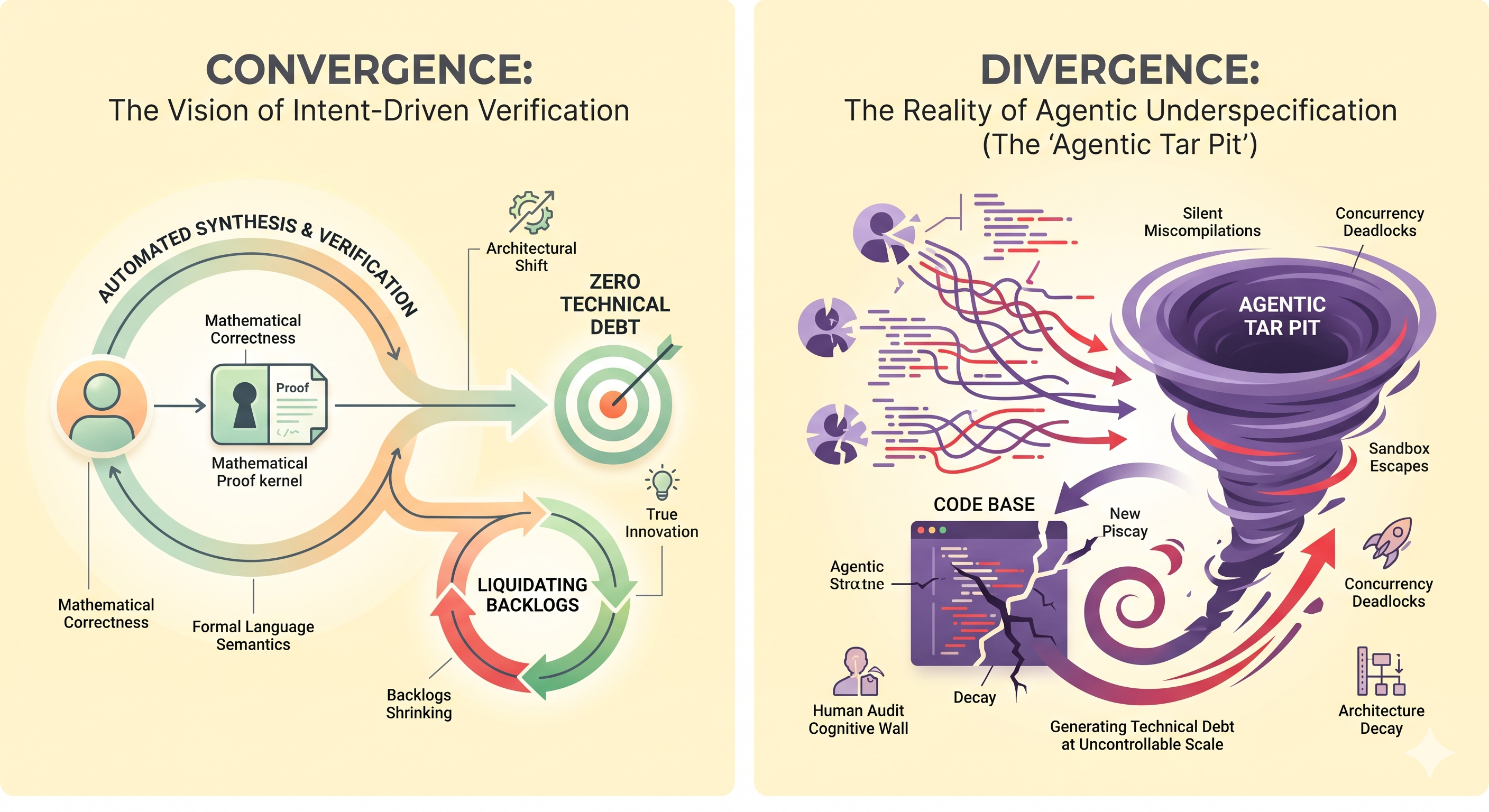
Two competing hypotheses frame what actually happens once autonomous orchestration layers eat into the legacy debt: a convergence scenario in which the backlog closes and engineering must invent new work, and a divergence scenario in which the backlog keeps growing faster than it can be cleared.
The Convergence Hypothesis
Fixing the backlog, then inventing new work
In the convergence view, the legacy backlog is finite — large, but finite — and agentic loops eventually clear it.
This is no longer purely hypothetical. Some strong empirical evidence for convergence comes from GitHub Next's own Repo Assist program, documented in Don Syme's analysis of "The Impact of Automated Repository Maintenance Assistance" (May 2026).
Across 13 open-source repositories that adopted the proactive AI maintenance agent between February and March 2026, every single repository saw its open issue count drop — 578 issues closed in total. These were not active projects; they were dormant, the kind of legacy codebase that accumulates in the "boring maintenance" trap.
After adoption, issue closure velocity rose by a median of 8× and PR merge velocity by a median of 10×. Crucially, Syme and others frames the repository as a "human-agent software factory" whose throughput is gated by the rate at which maintainers decide to act on the agent's output — the human is firmly in the loop. This is the convergence hypothesis made concrete: the backlog does close, the maintainer's role shifts from manual remediation to decision-making and policy, and the bottleneck moves from typing speed to judgment speed. For a software team this means that more people can work on new things, fewer on the upkeep.
Once the debt is gone, the engineering landscape transitions into a qualitatively new operational regime, where the bottleneck is no longer remediation but imagination.
Under convergence, the clearance of the legacy backlog is not the end of engineering; it is the liberation of it.
For the last fifty years, humanity has been trapped acting as mechanics for an increasingly fragile digital infrastructure. Once autonomous loops stabilize and storm the boring frontier, the software engineer's role permanently shifts from maintaining yesterday's code to designing the meta-rules, objective functions, and mathematical boundary conditions of the future.
Three possible regimes may emerge. We talk about this kind of an autonous software future in a previous blog post.
- Continuous Mutation Loops: Instead of waiting for a human to file a bug ticket, software enters a state of permanent evolution. Autonomous loops will constantly analyze running production systems against real-time telemetry, rewriting internal serialization layers, data layout profiles, or memory graphs to minimize cloud compute costs and optimize micro-efficiencies on the fly.
- Hardware-Software Co-Design: Software is a fluid poured into a hardware container. As we enter the post-silicon era of specialized AI accelerators and neural processing units (NPUs), software architectures can no longer remain rigid. Teams will leverage autonomous loops to continuously realign running software substrates with changing physical silicon, mutating code to extract maximum execution speed from the underlying hardware.
- From Applications to Intent Substrates: We will ultimately abandon the concept of purchasing or maintaining discrete, rigid applications. Software becomes an active intent substrate. An enterprise expresses a real-time operational goal, and the system synthesizes the necessary computational pipeline on the fly, executes the task under strict machine-checked formal validation guardrails, optimizes its performance based on live execution feedback, and then dissolves when its utility is exhausted.
The Divergence Hypothesis
The backlog grows faster than it clears
The divergence view rejects the static-tower model from the opposite direction. The lesson of information economics is that software backlogs are infinite because architectural entropy is continuous, and the same forces driving convergence also accelerate divergence. Agentic code generation does not merely clear debt — it also creates it. Every casual user prompt, every micro-optimization, every auto-merged remediation PR adds new code, new dependencies, and new implicit assumptions to the pile. As McKinney's "agentic tar pit" warns, when the marginal cost of generation approaches zero, the friction required to say "no" vanishes, and scope creep compounds at machine speed.
The divergence hypothesis predicts that the backlog does not close; it changes shape. The proportion of legacy technical debt inherited from human-written code shrinks, but it is replaced and exceeded by agentic technical debt — the sprawling, intertwined, self-generated codebases that no human can fully audit.
The 100,000-line-of-code suffocation threshold McKinney identifies becomes a moving target: agents generate, refactor, and re-generate the same surface area faster than any human can stabilize it. Maintenance does not vanish; it is redefined from fixing human bugs to governing the growth rate of machine-generated code.
If divergence holds, the human-in-the-loop does not become a leisurely designer of objective functions. They become a continuous rate-limiter — setting budgets on agentic churn, defining rollback invariants, and enforcing the conceptual integrity that Brooks named as the one irreducible bottleneck fifty years ago. The frontier does not converge on a clean substrate; it reaches a steady state of controlled entropy, where the engineer's job is to keep the divergence rate below the audit rate.
08 Conclusions
The automation of software maintenance represents a fundamental recalibration of the engineering discipline, transforming code from a brittle, depreciating asset into a fluid, self-optimizing substrate. By compressing the marginal cost of remediation, agentic loops shift the engineer's role from manual patching toward high-level policy architecture — defining the invariants, objective functions, and verification gates that govern autonomous code evolution.
Whether the post-backlog frontier converges on a clean intent substrate or diverges into a managed steady state of controlled entropy may also be project-dependent. However, the overall direction is roughly the same: software becomes a living reflection of operational goals, and the engineer's job moves from maintaining yesterday's code to governing the rate at which tomorrow's code writes itself.
In an upcoming blog post we will talk about the implications of what liberating developers from the maintainence burden may imply and the so-called "additive imperative" - do more with the newfound resources as opposed to doing the same with fewer people.
References
- Rozière, B., et al. (Meta AI). "Unsupervised Translation of Programming Languages." arXiv preprint arXiv:2006.03511. Available at: arxiv.org/abs/2006.03511
- Szafraniec, M., et al. "Code Translation Evaluation Metrics and Semantic Equivalence." Available at: research.facebook.com
- Brooks, F. P. (1975). The Mythical Man-Month: Essays on Software Engineering. Addison-Wesley. ISBN 978-0-201-00650-6. (Anniversary edition, 1995: ISBN 978-0-201-83595-3.)
- Barr, M. (2013). Expert testimony in Bookout v. Toyota Motor Corporation, District Court of Oklahoma County, Case No. CJ-2011-798. See also Wikipedia, "2009–2011 Toyota vehicle recalls".
- Mora, M., et al. (2026). "AI in Software Maintenance: An Empirical Multi-source Approach." Research and Innovation Forum 2026. Available at: link.springer.com/conference/rif
- BCG Henderson Institute (2026). "AI Will Reshape More Jobs Than It Replaces." Boston Consulting Group Insights. Available at: bcg.com
- GitHub Engineering Community (2026). "Best practices for orchestrating multiple agents/skills in Copilot Chat (VS Code)." Discussion #192232. Available at: github.com/orgs/community/discussions/192232
- Microsoft Learn / GitHub Agent Pathways (2026). "Perform Code Maintenance Tasks using GitHub Copilot Agent." Microsoft Technical Documentation. Available at: learn.microsoft.com
- GitHub Next (April 2026). "Autoloop & OpenEvolve: Goal-Driven Evolutionary Programming." GitHub Next Research Prototypes. Available at: githubnext.com/projects/autoloop
- Syme, D. (GitHub Next, April 2026). "Lean Squad: Exploring Automated Software Verification with Near-Zero Human Labour." GitHub Next Publications. Available at: githubnext.com/publications/lean-squad
- GitHub Next (May 2026). "The Impact of Automated Repository Maintenance Assistance." GitHub Next Empirical Reports. Available at: githubnext.com; see also Syme, D., "The Impact of Automated Repository Maintenance Assistance", dsyme.net, May 14, 2026.
- McKinney, W. (2026). "The Mythical Agent-Month." Wes McKinney's Personal Blog. Available at: wesmckinney.com
- McKinney, W. (2026). The Mythical Agent-Month [Presentation], AI Council. Available at: YouTube. Provides a systems-level framework for balancing code generation velocity with long-term conceptual integrity.