The K-Shaped Economy for Computer Science Funding
A K-shaped economy is what happens when a single shock sends one part of a system soaring while everything underneath it flatlines or falls — this is the effect we are seeing in the global economy in the last several years, and that is precisely what AI funding has done to academic computer science. What follows is a tri-lateral assessment of the funding and doctoral talent pipelines across the United States, the United Kingdom, and China — three unrelated funding architectures, pluralist, centralized, and command-driven, that converge on the identical outcome.
The UK is the purest case: centralized, ring-fenced, and suffocated by a 212% personnel-cost hyper-inflation that core systems research cannot survive. China has taken the most direct route, carving Artificial Intelligence into its own standalone first-class discipline separate from CS, with dedicated Schools of AI, siphoning quota and funding away from traditional computer science departments entirely.
The distortion has stopped being a temporary budget swing — it is entrenching itself in permanent faculty hiring, and researchers are learning to game the AI premium in ways that mask how deep the collapse runs. The end state, everywhere, is an emerging academic computing monoculture.
This post is something of a departure from other, more technical discussions.
Computer science is not a monolith, and it helps to set the scale before diagnosing the distortion. CSRankings.org, the field's widely-used publication-based ranking taxonomy, divides the discipline into 27 recognized research areas across four groups: AI, Systems, Theory, and Interdisciplinary Areas. Only five of those 27 — Artificial Intelligence, Computer Vision, Machine Learning, Natural Language Processing, and The Web & Information Retrieval — fall under the AI umbrella.
The other 22, spanning Systems (architecture, networks, security, databases, operating systems, programming languages, software engineering, and more), Theory (algorithms, cryptography, logic), and Interdisciplinary areas (HCI, robotics, bioinformatics, and more), are what this post treats as foundational or core computer science.
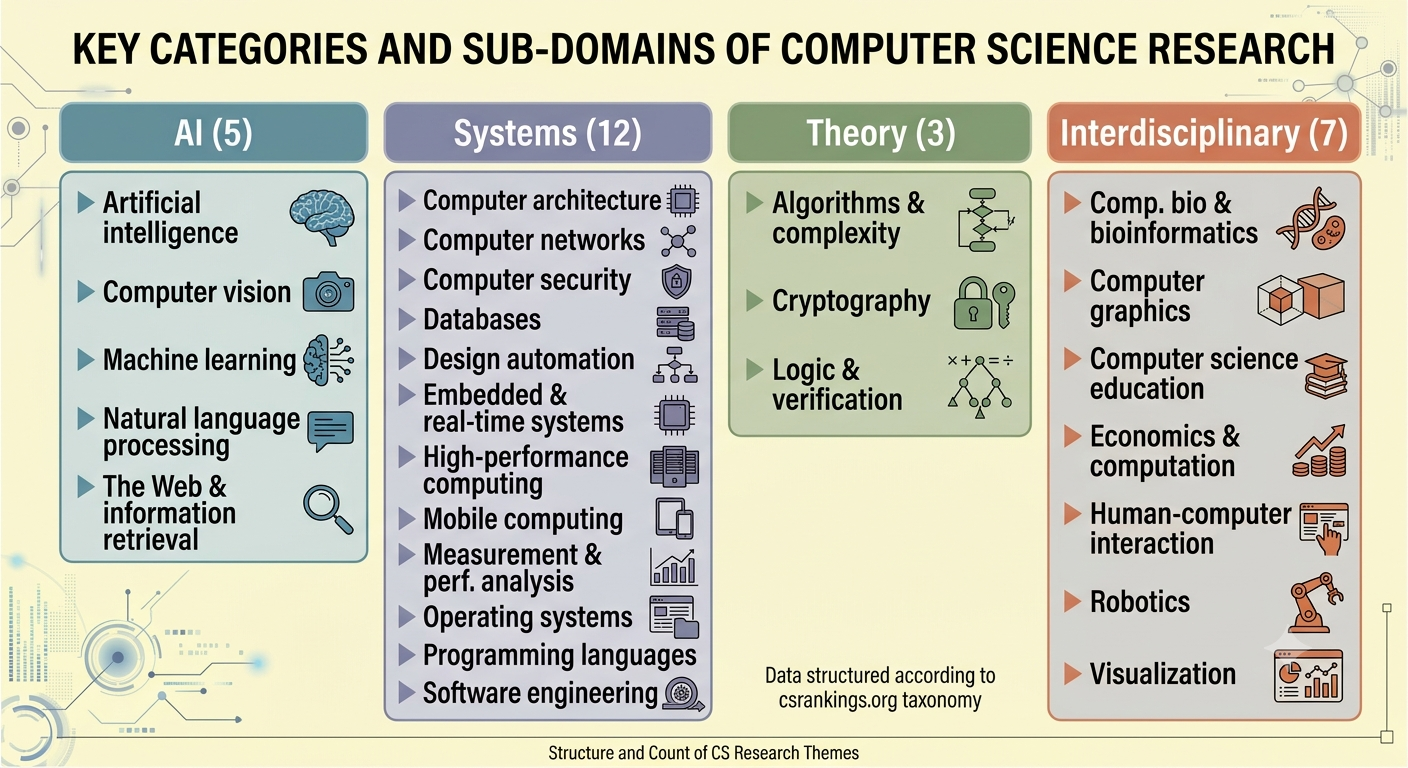
If funding, hiring, and prestige tracked that taxonomy evenly, AI would command roughly 5/27 — about 18.5% — of the field's attention, capital, and faculty lines.
Nothing could be further from the truth. As the sections below show, it commands far more than that, and the gap is the entire subject of this piece.
One methodological note before the numbers start: none of the dollar, pound, or yuan figures cited in this piece are adjusted for inflation. Inflation has been substantial across all three countries since 2020.
Lastly, I should mention that I have deep, first-hand familiarity with the US and UK academic systems, having lived and worked as a professor within both. I have no comparable familiarity with China's academic system — everything in the China-related sections is drawn from public, web-sourced data that I cite, rather than personal observation.
01 Summary of Findings
The synthesized data supports five central theses regarding the international computer science funding landscape, to varying degrees of confidence.
| # | Claim | Status | Key Evidence |
|---|---|---|---|
| 1 | A global academic computing monoculture is emerging | Confirmed | Three unrelated funding systems, pursued independently, arrived at the same result |
| 2 | The K-shape now appears permanent — embedded in faculty hiring, not just grant cycles | Partially confirmed | AI/ML structurally favored in new faculty tenure lines |
| 3 | Researchers are gaming the AI premium, masking the collapse's true severity | Confirmed | Systems work relabeled in ML language to access ring-fenced capital |
| 4 | The UK went into AI heavily, suppressing the rest of CS | Confirmed | £1.6 billion UK ring-fence, cushioned only partially by the US's pluralistic agencies |
| 5 | UK overheads choke PhD hiring relative to the US and China | Confirmed | Staggering recent cost growth (£372m/year UK NI hike, 8% stipend jump in 2025 alone) compounds the 80% fEC reimbursement deficit |
Thesis 1: The Emergence of a Global Academic Computing Monoculture
Status: Confirmed. The K-shaped funding economy is a global systemic threat, not just a localized policy issue. As research institutions in the US, UK, and China prioritize high-prestige machine learning software, the research pipeline loses foundational competencies in systems engineering, compiler design, database architecture, and hardware.
This creates a problem in the making, where global research invests heavily in AI, while potentially hollowing out the foundational systems and physical platforms required to optimize, secure, and scale that AI, and to further computer science as a whole.
Thesis 2: The K-Shape Has Become a Permanent Feature of CS, Embedded in Faculty Hiring Rather Than Grant Cycles
Status: Partially confirmed. China and the US each supply a stark version of this permanence, by different means. China doesn't just redirect grant money — Tsinghua, Peking, and other Double First Class institutions built standalone Schools of Artificial Intelligence with their own deans and autonomous faculty search committees, an organizational structure no single funding reversal can undo.
The US shows the private-capital mirror: an endowed chair is funded in perpetuity by design, not for a grant's multi-year term, and donor gifts are increasingly writing the AI premium directly into the title — the Simonyi Endowed Chair for AI, the Amazon Professor of Machine Learning, an entire computing school renamed for a single gift. A grant line can be reallocated next fiscal year; a named chair or a dean's office cannot.
The mechanism is well supported in the UK too: EPSRC's responsive-mode constraints push hiring committees toward AI-adjacent candidates, and the distortion has moved beyond temporary budget swings into permanent demographic structure. The specific "60–70%" figure sometimes cited for this shift isn't backed by a UK-wide dataset this piece has access to — what's better supported is the direction, not the exact tilt: a retiring core-computing professor is structurally less likely to be replaced like-for-like than an AI/ML researcher is to be hired.
Even departments that resist the pressure and open a dedicated systems line frequently lose the hire to industry, where the commercial premium for systems engineers dwarfs standard academic pay. Because faculty lines outlast any single funding cycle, this is the most durable form of the K-shape: a funding pivot can reverse in a year, but a hiring pivot takes a generation to undo.
Thesis 3: Researchers Are Gaming the AI Premium, Which Masks the True Severity of the Collapse
Status: Confirmed. Faced with flatlined, high-deficit responsive-mode funding, systems and compiler researchers are structurally incentivized to wrap core infrastructure work in token machine learning language — a learned index instead of a B-tree, a neural branch predictor instead of a hardware heuristic — simply to access ring-fenced funding capital.
This behavior inflates official graduation and hiring statistics under the generalized Computing banner, masking how thin the actual foundational-systems pipeline has become. The administrative data looks healthier than the underlying discipline is.
The backing for this isn't just anecdotal. A Northwestern Kellogg Innovation Institute 2026 study matched confidential early-stage NIH and NSF proposal submissions against the agencies' full historical award registries and found that AI-aligned proposals won funding at a higher rate — but the resulting papers skewed toward ordinary, incremental output rather than major breakthroughs, and applicants converged on the same previously funded templates to clear review.
In the worst case, the AI premium rewards the label, not the result — which is precisely the mechanism that lets a hollowed-out systems pipeline hide behind a healthy-looking Computing banner.
Thesis 4: UK Went Into AI Heavily, Suppressing Other Areas of CS
Status: Confirmed. The US features a highly fragmented, pluralistic landscape divided across independent federal agencies (NSF, DARPA, DOE, DoD, and NIH). While the US invests heavily in AI through the NSF's National AI Research Institutes, these are shielded via specialized appropriations. If the NSF pivots, a US systems researcher can transition their proposals to DARPA or the DoE, maintaining systemic balance and protecting core CS infrastructure from being crowded out.
The UK features a highly centralized funding model. Because almost all academic computer science capital flows through a single entity — UKRI (via the EPSRC) — the system is highly vulnerable to political, top-down "mission-driven" crowding out. When the UK government committed a £1.6 billion national ring-fence to AI, the broader open-response, applicant-led pot flatlined. Researchers in core software engineering, operating systems, and theory are forced to participate in the AI premium, adapting their proposals to include machine learning elements to win funding.
Thesis 5: Overheads Are Choking the Ability to Hire PhD Students in the UK Compared to the US and China
Status: Confirmed. While funding a PhD student is exceptionally expensive in both countries, the underlying mechanics of the UK's fEC model create a distinct structural bottleneck.
The US Financial Workaround: When an NSF grant approves a PhD student's stipend and tuition at an institution like CMU, the federal government pays 100% of those direct costs, plus 100% of the negotiated institutional F&A overhead added on top. Furthermore, if a US research grant lapses, departments routinely transition PhD students onto institutional Teaching Assistantships funded by undergraduate tuition. This provides a resilient financial buffer that prevents the sudden downsizing of doctoral cohorts during funding shifts.
The UK 80% Rule Deficit: UKRI only pays 80% of the total calculated fEC on standard grants. At Imperial, where an international PhD student costs £104,600 a year under TRAC guidelines, the grant only provides £83,680. The university or department must internally absorb a £20,920 annual deficit per student. This makes departments highly risk-averse, choking off standard PhD positions unless they are tied to fully subsidized, ring-fenced AI Centers for Doctoral Training.
The fixed 80% ratio is not even the most urgent part of the squeeze. What should worry departments more is how fast the underlying bill itself has moved in just the last few years, independent of any reimbursement rule. The 2024 Autumn Budget's employer National Insurance hike alone is projected to cost the UK higher-education sector £372 million a year, landing directly on the wage bill for every postdoc and PhD supervisor a department employs. In the same window, UKRI raised its minimum PhD stipend by 8% for 2025–26 alone — its largest real-terms increase since 2003. A department now has to absorb these annual shocks on top of the 80% deficit, not instead of it.
China's Direct Labor-Cost Model: China avoids the UK's specific bottleneck by a different route than the US. Because Chinese grant systems fund PhD students almost entirely through direct supervisor labor-cost allocations rather than fEC-style institutional overheads, universities never face an equivalent of the UK's 80% Rule Deficit at all. Faculty can scale doctoral headcounts against their grant balance directly, without the compounding overhead drain UK departments absorb on top of every studentship.
02 US: The Pluralist Buffer, the Private Overhang
In the United States, foundational computer science funding is tracked primarily through the NSF Directorate for Computer and Information Science and Engineering (CISE). The landscape is fragmented and pluralistic: the NSF, DARPA, the Department of Energy, and the Department of Defense each operate independent portfolios with separate appropriations.
CISE Division Funding Longitudinal Trends
Congress appropriates lump-sum pools at the divisional level, meaning definitive longitudinal funding tables do not exist for specific sub-programs (like Robust Intelligence or Algorithmic Foundations). Program directors dynamically allocate funds from these pools based on proposal volume. Total CISE allocation rose from $864.96 million in FY 2014 to $1,150.78 million in FY 2023 — not explosive growth.
That slow-and-steady trend did not survive FY 2024–FY 2026. The White House's FY 2026 budget request proposed cutting NSF's entire budget by more than half — from $8.8 billion to $3.9 billion — before Congress rejected the depth of that cut and appropriated $8.75 billion instead, still 3.4% below FY 2024 levels. The interim was rougher than the final number suggests: NSF halted new grant awards entirely in May 2025 and capped indirect-cost reimbursement at 15%, while terminating 1,752 grants worth roughly $1.4 billion that officials judged no longer aligned with agency priorities, and disestablished the CISE and Cyberinfrastructure advisory committees that April. NSF also restructured its peer review process that December, cutting the minimum external-reviewer count from three to two and making panel discussions optional — changes the agency attributed to a proposal backlog and program-officer losses of up to a third in some directorates.
The lion's share of that FY 2014–FY 2023 expansion flowed to Information Technology Research (ITR), which nearly doubled from $85.35 million to $165.74 million, and Information & Intelligent Systems (IIS), which climbed from $176.58 million to $248.16 million. Foundational CCF grew far more modestly, from $179.03 million to $218.57 million.
Mapping Artificial Intelligence in the NSF Hierarchy
Artificial Intelligence maps across the CISE hierarchy through four primary entry points. The core home is IIS's Robust Intelligence cluster (Program Code 7495), funding machine learning, computer vision, and NLP — the IIS line item's surge reflects capital flowing here. The applied homes branch into Human-Centered Computing for human-AI interaction and Information Integration & Informatics for big data mining.
The hardware foundations fund neuromorphic computing and AI chip architecture across CCF and CNS. And the cross-cutting overlay is ITR, a flexible vehicle that co-funds massive multi-agency initiatives like the National AI Research Institutes without permanently altering individual divisional caps.
The US Doctoral Pipeline Shift: CRA Taulbee Analysis
This spending architecture directly shapes the domestic talent pipeline. The CRA Taulbee Survey's Table D4, which tracks specialty areas of new PhD recipients, provides empirical proof of a pivot toward AI/ML at the expense of core systems architectures.
AI/ML PhDs grew from 14.2% in 2010 to over 25% by 2023–24 — steady, exponential growth. Every traditional subfield — software engineering, hardware architecture, programming languages, scientific computing — saw a proportional drop, landing flat or contracting. The pipeline is not rebalancing; it is concentrating.
This talent pipeline transformation introduces a self-reinforcing feedback loop. Because funding bodies like the NSF dynamically allocate capital out of core divisional pools based on incoming proposal volume, the rising concentration of AI/ML PhDs generates an overwhelming volume of AI-focused grant requests. This automatically channels funds away from foundational computing segments like CCF.
The saving grace of the American model is that the agencies are independent. When the NSF pivots toward AI through its National AI Research Institutes, a systems researcher squeezed out of a core division can traditionally pivot to a defense or energy portfolio.
The K-shaped distortion is present — AI/ML is absorbing a disproportionate and growing share of the pipeline — but it is cushioned by a pluralistic sovereign buffer that the UK entirely lacks.
The NSF AI Institute Network: Concentration Without a Center
The National AI Research Institutes program is the clearest evidence that the US is not immune to the same impulse present in other countries we consider to concentrate AI capital into flagship structures — it simply does so in a shape that matches its pluralist architecture.
Since the first cohort of seven institutes launched in 2020, NSF has grown the network in successive waves; it now spans 29 active institutes across more than 500 partner institutions. The latest wave, announced July 29, 2025, added five new institutes — at Cornell, UT Austin, CU Boulder, UIUC, and Brown — plus a new central coordinating hub, backed by a $100 million joint investment from NSF, Capital One, and Intel.
Each institute typically receives roughly $20 million over five years — modest next to the UK's single flagship Alan Turing Institute or China's dedicated Schools of Artificial Intelligence, examined in the next two sections. Where the UK and China each concentrated their AI ambitions into one sovereign node, the US built a federation: dozens of smaller, university-anchored, often industry-co-funded institutes, no single one large enough to dominate the field the way one national institute can.
The K-shape is present either way — capital still concentrates around AI-branded structures rather than flowing evenly through the responsive-mode system — but its shape mirrors the architecture that produced it.
The Private Capital Overhang
Every figure examined so far in this section is federal. It is not the dominant number. US-based AI startups pulled in $159 billion in venture capital in 2025 alone — a single year's private AI investment more than a hundred times NSF's entire CISE budget ($1.15 billion in FY 2023).
Next to that, the federal apparatus this section has spent a lot of time dissecting is a rounding error.
Private capital does not stop at company formation; it reaches directly into the doctoral pipeline the rest of this piece treats as a federal artifact. Amazon's AI PhD Fellowship committed $68 million across the 2025–2026 and 2026–2027 academic years, funding more than 100 students at nine universities including MIT, Stanford, and Johns Hopkins, each paired with an Amazon research mentor. NVIDIA runs a parallel Graduate Fellowship; Microsoft Research funds its own. None of this shows up in an NSF budget line, and none of it is obligated to correct for the AI/ML concentration the Taulbee data already documents — if anything, it accelerates it, since the money follows the same discipline the federal pipeline is already tilting toward.
The same capital that funds the pipeline also depletes the faculty meant to run it. Between 2004 and 2018, 211 AI professors left academia in full or in part — 149 to industry jobs, 62 to found startups of their own — with Google and DeepMind alone hiring 22 tenured or tenure-track AI faculty over that window. The departures measurably reduced AI-startup formation among the affected professors' own students.
The Endowed Chair Ladder
There is no Crunchbase-style tracker for this next layer, only a long tail of individual gifts — but the pattern is consistent, and the scale keeps climbing from a single chair to an entire school:
- University of Washington — a $10 million donation from Microsoft technical fellow Charles Simonyi and his wife Lisa established the Simonyi Endowed Chair for AI in November 2025; its inaugural holder, Noah Smith, had previously held a title that already made the point — the Amazon Professor of Machine Learning.
- UC Irvine — SAP donated $2 million in March 2025 to endow an AI chair.
- Georgetown — a $13.7 million gift the same year — one of the largest in the history of Georgetown's computer science department — created the Bertrand Endowed Chair in Computer Science.
- RIT — a $24 million commitment in June 2026 to fund an AI institute directorship and three professorships.
- University of Chicago — took in $50 million from alumni Joe and Rika Mansueto in 2026 for a university-wide AI initiative.
- Binghamton University — backed by Bloomberg LP cofounder Tom Secunda and other donors, opened the first independent AI research center at a US public university on a $30 million commitment.
- USC — Nvidia director Mark Stevens and his wife Mary gave $200 million in May 2026, enough to rename the university's entire computing school the Stevens School of Computing and Artificial Intelligence.
None of this shows up in a federal budget line either, and unlike the fellowships and VC totals above, nobody is aggregating any of it into a single number — which may understate, not overstate, how far private capital now reaches into the university faculty roster and org chart alike.
03 UK: Centralized Funding and Growing Overheads
The United Kingdom is the purest implementation of the K-shaped funding economy, and the most structurally devastating. Academic computer science is funded almost entirely by a single agency — the Engineering and Physical Sciences Research Council (EPSRC), under UK Research and Innovation — operating within fixed macro budget limits dictated by central spending reviews. A second, much smaller public funder exists outside UKRI entirely; the closing subsection of this section explains why it barely changes the picture.
The K-Shape Mechanics: Top Arm, Bottom Arm
The current structural crisis in UK academic CS research is a textbook execution of a K-shaped funding economy, driven directly by how the state has centralized and ring-fenced its capital injections. When the government chooses to engineer massive, top-down tech acceleration, it does not expand the overall computing envelope proportionally. Instead, it splits the discipline into two diverging vectors.
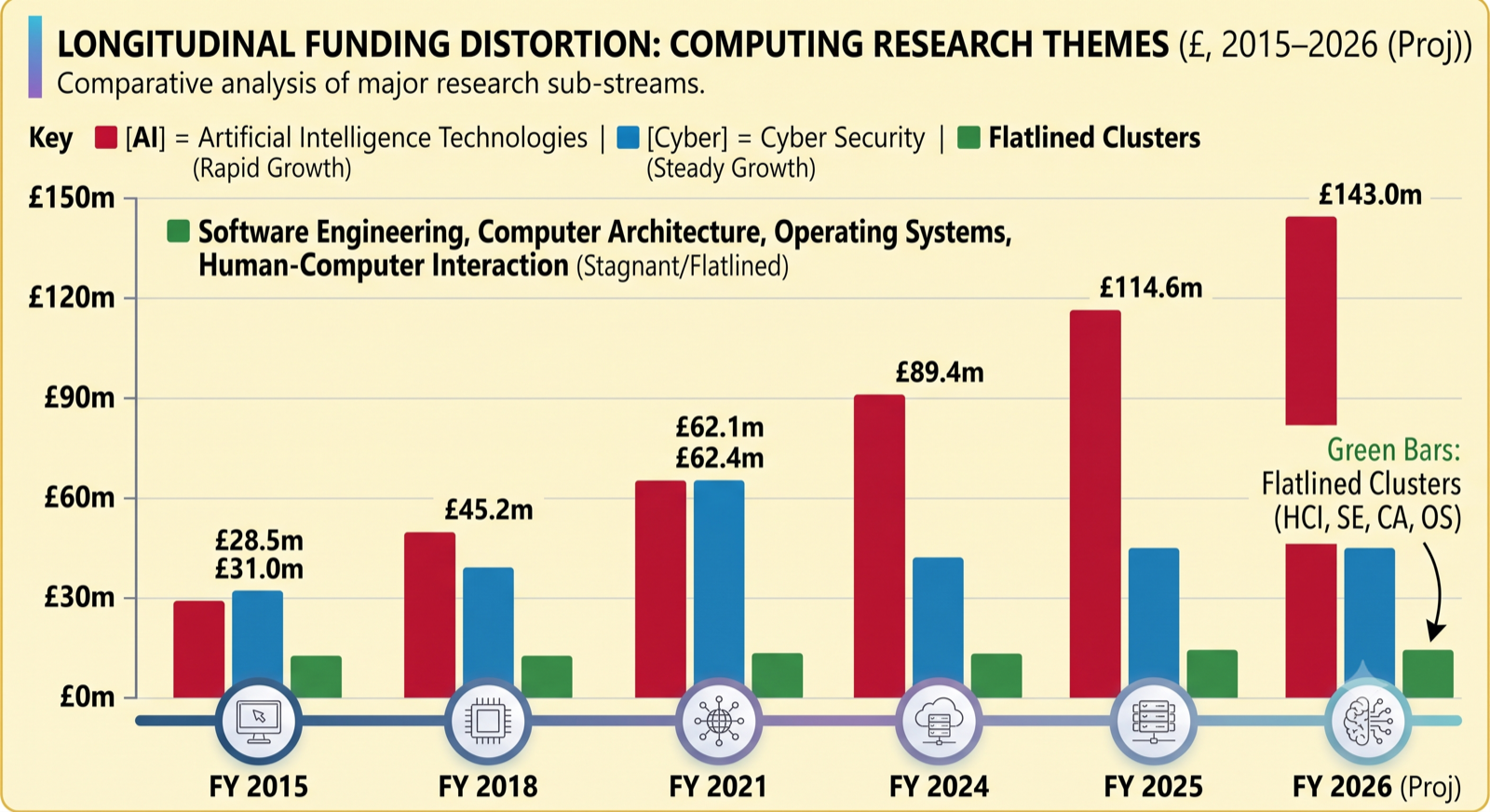
- The top arm is populated by directed AI injections: massive funding for Centers for Doctoral Training in AI (£117 million), the launch of nine new national Research Hubs for AI (£100 million) to capture the generative wave, fully state-subsidized rings protecting the AI Safety Institute and Turing Institute programs, and direct allocations for sovereign compute hardware like Isambard-AI. This creates a highly liquid, protected ecosystem where human capital and grant applications are artificially ballooned by state mandate.
- The bottom arm is the baseline systems erosion. Because EPSRC operates within fixed macro budget limits, these multi-million-pound strategic allocations are zero-sum. Capturing capital for the top arm requires pulling it out of the responsive-mode, applicant-led pools that traditionally sustain core CS. Funding lines for software engineering, operating systems, architectures, programming languages, and theoretical CS have remained entirely flatlined.
The mathematical reality is unforgiving. When a subfield faces completely flatlined portfolio allocations while its human asset costs continue their multi-year climb, it does not mean research stays steady. It's hard to see how it does not result in a severe, absolute headcount contraction in active core computing researchers.
The Inception and Escalation of the Alan Turing Institute
The centralization is not recent. It is the culmination of a decade-long policy pivot that began with the creation of the Alan Turing Institute. Tracing its financial evolution against the broader computing pie exposes a clear historical pattern: top-down, state-directed nodes have consistently outsized investigator-led grants from day one.
The structural bias was codified in the 2014 UK Spring Budget. The coalition government carved out an initial £42 million over five years from the "Eight Great Technologies" capital pool. When the Institute opened its doors in 2015, that launch capital was paired with an additional £25 million matched by its five founding university partners (Oxford, Cambridge, UCL, Warwick, and Edinburgh).
The asymmetry is stark. At that exact point in history — FY 2015 — the entire active value of open-response, peer-reviewed grants for AI Technologies across every university in the UK was only £28.5 million.
By 2018, the apparatus shifted from capital infrastructure to active program redirection. The Turing Institute was awarded an additional £38.8 million through Wave 1 of UKRI's Strategic Priorities Fund to execute the AI for Science and Government initiative. Instead of faculties defining their own research directions through responsive-mode proposals, the state increasingly channeled funds into targeted, mission-driven "Grand Challenges" managed by the central institute.
By 2024, the Treasury committed another £50 million to £100 million package directly to the Turing Institute, designed to double down on national defense, environmental modeling, and healthcare AI. This injection occurred over the exact window where baseline curiosity-driven CS lines flatlined and applicant-led grant streams faced sudden operational pauses.
By the time SOFAIR and BOLD — two new UCL/Oxford AI labs detailed below — were funded in June 2026 via a fresh £60 million UKRI deployment, they were not entering a balanced ecosystem — they were layering atop a deeply entrenched, decade-old structural blueprint.
The K-shaped computing economy is not a temporary budget anomaly; it is an intentional architectural decision by the state to move away from distributed academic freedom in favor of centralized sovereign tech infrastructure.
Systemic Realities and the 2025 Pauses
The 2025 metrics highlight a severe operational turning point. Faced with immense budgetary pressures, the major UK research councils — including the EPSRC — officially suspended multiple key applicant-led grant streams in 2025. This allowed the agency to protect existing multi-year commitments while shifting toward a top-down "Three Buckets" model (curiosity-driven, strategic priorities, and business scaling). While baseline "curiosity-driven" computing domains flatlined, ring-fenced funds saw massive injections, paving the way for targeted multi-million-pound initiatives like the Fundamental AI Research Labs.
The June 2026 UKRI Capital Concentration: SOFAIR & BOLD
The real-world execution of this K-shaped economy crystallized on June 23, 2026, when UKRI, through EPSRC, officially bypassed traditional responsive-mode computing structures to deploy a massive strategic capital allocation. Backed by up to £60 million over six years, the state engineered a centralized research axis between University College London and the University of Oxford, designed to rethink the underlying cost and computational limits of modern models.
The Science of Fundamental AI Research (SOFAIR) Lab, hosted at UCL under Professor David Barber in tight collaboration with Oxford, Cambridge, and Edinburgh, is funded to break Big Tech's data-center monopoly. Rather than wrapping existing commercial systems, SOFAIR is building open-source multimodal frontier foundation models designed to execute robust reasoning directly on widely available, modest consumer hardware.
The British Open-ended Learning and Discovery (BOLD) Lab, hosted at the University of Oxford and collaborating with UCL and Imperial College London, focuses on alternative optimization mechanics. The lab aims to move completely beyond traditional backpropagation, training machines to learn efficiently under real-world constraints across human-centric environments and autonomous robotics.
Dissecting the Allocation Pie
The cumulative value of the active EPSRC Information and Communication Technologies (ICT) Theme portfolio for FY 2026 sits at approximately £353.3 million. Layering the centralized AI allocations and standalone institutional draws against this total exposes the geometric reality of the K-shaped landscape:
| Category | Annual Value | Share of ICT Portfolio |
|---|---|---|
| AI Technologies sub-area | £143.0m | 40.5% |
| Architectures & OS + Software Engineering | £48.2m (£19.1m + £29.1m) | 13.6% |
| Turing Institute annualized draw | £10m–£15m | — |
| New UCL–Oxford axis (SOFAIR & BOLD) | £10m annualized (£60m over six years) | — |
The true impact is felt in liquid capital — newly awarded annual grants, not historical commitments.
When the structural commitments of the Turing Institute and new hubs like SOFAIR and BOLD are subtracted, these specialized AI nodes ingest up to 25% to 30% of all newly deployable computing capital.
The remaining open-response applicant pool competes for a dissolving remnant of the baseline national budget.
The Rising Overheads
The rising cost of academic personnel acts as a primary operational barrier within the UK research ecosystem. Under the Full Economic Costing (fEC) and Transparent Approach to Costing (TRAC) guidelines, research proposals must calculate the true, fully unbundled operational footprint required to sustain human assets on a project. Longitudinal data from 2010 to 2026 demonstrates that the real financial cost of supporting a researcher has nearly doubled (Figure 3 below charts the trajectory). This compounding inflation is disproportionately driven by surging university indirect overheads and facility estates charges rather than take-home pay or baseline stipends.
The overhead-salary divergence sharpens the picture. Over the last sixteen years, a postdoctoral researcher's base salary grew by 56.6%. In the same window, indirect university overheads levied on top of that salary expanded by 125.7% — institutional maintenance operations (HR, finance, generic administration) are inflating significantly faster than direct labor compensation.
On the doctoral side, the Research Training Support Grant and integrated university support overheads grew 5.8×, rising from a baseline of £1,600 to £9,238. This surge highlights the compounding cost of cloud compute allocations, complex licensing fees, and laboratory equipment required to facilitate modern CS dissertations.
The workforce headcount squeeze follows directly. Because the total cost to a grant for both a postdoc (+95.4%) and a PhD candidate (+95.2%) has essentially doubled, a fixed, flatlined funding portfolio represents an immediate workforce reduction. A grant pool that comfortably supported two full-time postdocs in 2010 can now barely sustain one, shifting university departments toward heavily protected, strategic funding avenues like centralized Centers for Doctoral Training.
Escalating Cost Over Time: The Imperial Example
Using Imperial College London as the structural reference point, the financial math is unforgiving. In 2010, an international PhD student cost roughly £33,500 per year. In 2026, the same asset costs £104,600 — a +212.2% hyper-acceleration. This is not take-home pay; it is institutional tax.
The student stipend (£26,500 with London weighting) is the smallest piece of the total. Before a single pound of it reaches the student, the host institution extracts £78,100 in tuition, TRAC indirect overheads, and lab-weighted estates charges to cover physical space and administrative functionality.
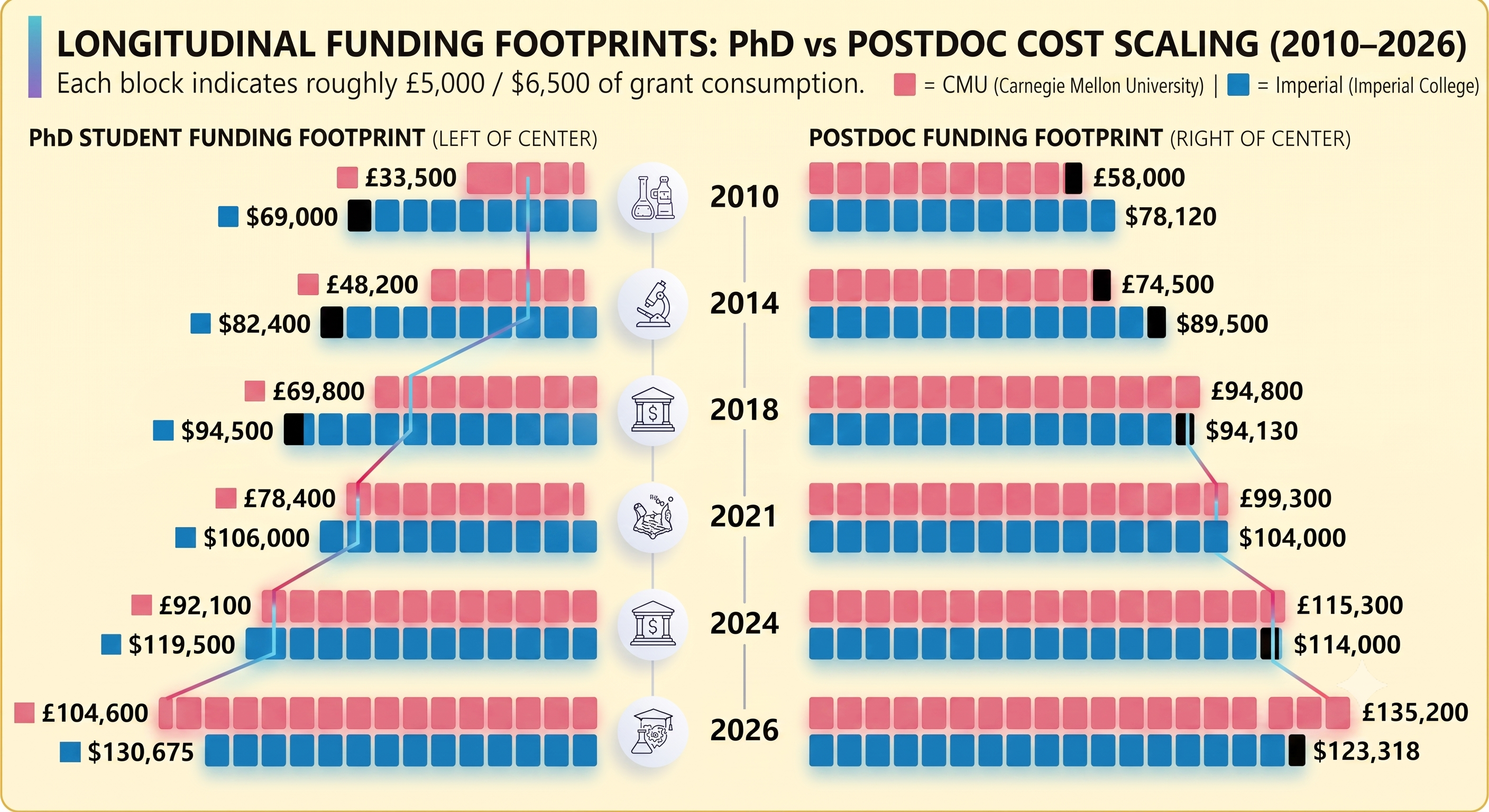
The contrast with the United States is sharp. At Carnegie Mellon University, the 2026 MTDC standard produces an annual grant drain of roughly $125,000 — a +89.4% linear trajectory from 2010. Crucially, US federal accounting — under the OMB's Uniform Guidance (2 CFR 200) — reimburses 100% of allowed direct costs plus 100% of the negotiated F&A overhead, whereas UK research councils often reimburse only 80% of fEC costs on standard grants.
UKRI pays only 80% of calculated fEC on standard grants. At Imperial, where an international PhD student costs £104,600 per year, the grant provides £83,680. The department must absorb a £20,920 annual deficit per student — nearly £84,000 over a four-year doctoral timeline.
Departments tend to become risk-averse, choking off standard PhD positions unless tied to fully subsidized, ring-fenced AI Centers for Doctoral Training.
Imperial is not an outlier. Times Higher Education reported the sector-wide research shortfall had climbed past £5 billion, and Research Professional News put the annual cash loss on research at £6 billion across UK universities. Both track back to the same mechanism: the Innovation Research Caucus's own analysis of UKRI grants documents structurally low fEC recovery rates, and Times Higher Education has separately warned that the cross-subsidisation universities lean on to cover the gap — largely international student tuition — is itself faltering.
The Faculty Squeeze
The K-shaped funding economy does not stop at the doctoral and post-doc cohort levels; it actively dictates the permanent demographic design of computer science departments. Across elite UK institutions, junior faculty hiring — the lecturer and assistant professor pipeline — has become heavily, systematically biased toward AI and ML specializations.
Departments cannot decouple payroll from external revenue realities: when the bottom arm of the K flatlines for foundational CS, hiring follows the ring-fenced liquidity. AI/ML clusters now capture a significant fraction of both new junior tenure-track appointments and that of PhD students and postdocs.
Junior faculty are judged aggressively on their ability to secure external research capital during initial probation periods. Because EPSRC responsive-mode pots for systems, software engineering, databases, compilers, etc. are severely constrained, a newly appointed lecturer in traditional computer architectures faces an existential funding gap. Departments minimize financial downside by hiring candidates whose portfolios intersect with high-liquidity AI hubs and national institutes.
Elite hubs have created entirely parallel academic units — such as Imperial College London's I-X initiative or dedicated AI research institutes across the Russell Group — SOFAIR and BOLD among them — that possess independent hiring authority. These lines are ring-fenced for machine learning, computer vision, and autonomous systems, and traditional CS departments find their centralized faculty lines cannibalized or diverted to seed these high-prestige, state-subsidized centers.
The funding bias has warped the applicant funnel. Recognizing that pure systems positions are disappearing, graduating PhDs and postdocs engage in tactical semantic adjustments. A junior researcher whose core competency is high-performance distributed networks will frame their entire application packet around accelerating large language model clusters or distributed inference training. The hiring committee, searching for explicit keyword alignment to pass central university budget approvals, routinely favors these hybrid applications over pure infrastructure engineers.
No dataset cited here tracks the exact share of new UK CS appointments going to AI/ML versus core computing — the mechanism is better supported than the headcount. EPSRC's responsive-mode pots for systems and compilers are constrained enough to leave a newly hired lecturer in those areas at a real funding disadvantage, and hiring committees respond accordingly. If that persists, core-computing hiring plausibly gets rarer with each unreplaced retirement, with a knock-on risk to who teaches mandatory operating-systems and compiler courses — but this piece doesn't have the departmental-level data to confirm how far that's already gone.
ARIA: Broad Portfolio, Narrow at the Computing Edge
"A single agency" needs one qualification. The Advanced Research and Invention Agency (ARIA) — a DARPA-style body formally established on January 26, 2023, funded with an initial £800 million and a further £1 billion committed for 2025–2029, operating entirely independently of UKRI — is a second UK public funder that can direct money toward computing. It works nothing like EPSRC's responsive-mode grant pool: no open calls, no peer-reviewed proposals, just a small number of Programme Directors hand-picking high-risk "opportunity spaces" to bet on directly.
Taken as a whole, ARIA's portfolio is genuinely diverse. Of its roughly fourteen opportunity spaces, only about two are explicitly AI-labeled — the rest fund innate immunity, neural interfaces, mitochondrial engineering, climate and atmospheric systems, synthetic plants, ecosystem resilience, and robotics. On paper, ARIA looks like the one UK funding structure that isn't K-shaped.
Narrow the lens to computer science specifically, though, and the diversity evaporates.
Every ARIA programme that touches computing is an AI programme. Scaling Compute (£100 million, including a £50 million "Scaling Inference Lab" open testbed) funds non-von-Neumann computer architecture, mixed-signal CMOS circuits, and networking — but its stated purpose is cutting the energy cost of AI inference, not computer architecture for its own sake. Scaling Trust (~£50 million) funds cryptography and formal verification extended into cyber-physical systems — but the target application is securing AI agents that coordinate and negotiate with each other. Safeguarded AI (£59 million) funds a formal mathematical assurance toolkit — built specifically so fleets of AI agents can be verified at scale without human review.
Roughly £209 million, and all three programmes are computer architecture, cryptography, and formal methods work, wearing an AI label because that is the only door ARIA's computing money walks through.
04 China: State-Directed Guidance and Sovereign AI Schools
In China, the K-shape is not an organic market accident — it is an explicit, state-directed blueprint managed by central educational decrees. Data collection is completely centralized under the Ministry of Education (MoE), which uses a system of First-Class Disciplines rather than a bottom-up census. Historically, almost all CS doctorates fell under Computer Science and Technology, split internally into Computer System Structure (hardware), Computer Software and Theory (compilers/SE), and Computer Application Technology (applied/early AI).
The Strategic Emergence of Independent AI Majors
Following the launch of China's New Generation AI Development Plan, the MoE shattered the traditional taxonomy by authorizing Artificial Intelligence as an independent, standalone First-Class Discipline. This granted AI the legal and bureaucratic authority to establish its own degree-conferring paths, separate from standard computer science. Top-tier Double First Class institutions — Tsinghua and Peking University among them — constructed dedicated, fully autonomous Schools of Artificial Intelligence (人工智能学院) with independent deans, isolated laboratory spaces, and autonomous faculty search committees.
This administrative segregation has fundamentally transformed the educational background of graduating PhD candidates. The standalone AI pipeline focuses on advanced mathematical optimization, matrix computing, deep learning architectures, and neural dynamics. Students routinely bypass standard computer engineering sequences like assembly or operating systems to accelerate domain-specific applications.
The traditional CS pipeline maintains rigorous code-level engineering sequences but faces reduced access to frontier sovereign compute clusters. The result is a deeply asymmetric talent base. AI schools generate specialized mathematicians capable of training frontier models, but these graduates lack the deep systems engineering training needed to optimize execution layers. Traditional CS departments — starved of strategic funding pools — struggle to maintain the foundational systems infrastructure that serves as the actual physical bedrock for those identical AI models.
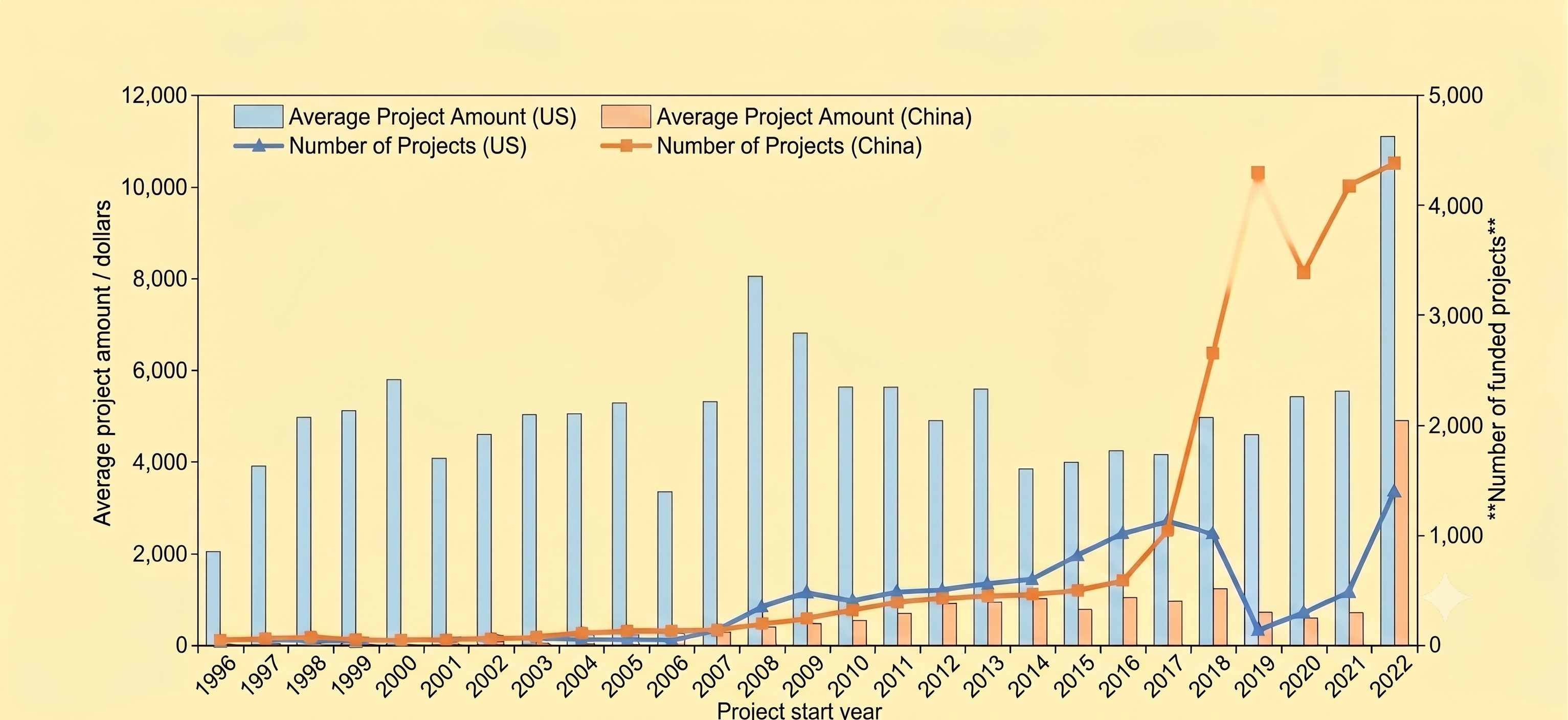
Independent, peer-reviewed bibliometric work backs up the shape of this story. A 2025 study comparing US and Chinese AI project-level funding data found that the US began funding AI decades earlier — its first AI-related grant dates to 1964 — and stayed the dominant sponsor through the mid-2000s. China's first AI grants, funded by NSFC, did not arrive until 1986. But the trajectories inverted after China's 2017 AI Development Plan: China's project count grew exponentially and overtook the US after 2016, while US funding growth flattened. By the early 2020s China was funding roughly three times as many AI projects a year as the US — though the US still commands a larger average award per project, with 88.6% of its AI funding concentrated in just three agencies: NSF, NIH, and DoD.
The Scale of Faculty and Doctoral Cohorts
The state-driven segregation has created highly concentrated talent hubs. Tsinghua University operates a multi-tiered footprint: the traditional Department of Computer Science and Technology alone maintains roughly 41 full professors, 51 associate professors, and 63 authorized PhD supervisors. The School of Artificial Intelligence has rapidly concentrated over 35 core AI professors — including prominent names like Dai Qionghai, Zhang Yaqin, and Zhu Jun — supplemented by an elite multi-departmental cross-disciplinary cluster.
Peking University splits general computer systems from sovereign general AI. The School of Computer Science holds 113 full-time faculty members (63 full professors, 50 associate or assistant), while the School of Intelligence Science and Technology operates alongside the Beijing Institute for General Artificial Intelligence (BIGAI) under Zhu Songchun.
Beihang University's School of AI lists 61 full-time teaching and research personnel, with a 36% national-level talent ratio including 1 Academician, 8 national-level leading talents, and 13 national-level young talents. Beihang secured independent AI cross-disciplinary doctoral degree conferring rights and was granted the Artificial Intelligence National State-Demanded High-Level Talent Cultivation Special Program — bypassing general university quotas to ingest an independent, ring-fenced stream of doctoral students.
The Evolution of the Chinese Doctoral Funding Engine
Tracking the financial footprint of doctoral candidates in China reveals a systematic transition from a legacy state-welfare model to a highly structured, co-funded research package. While Western frameworks like the UK's fEC struggle with hyper-inflated central university overheads, China has tightly insulated student packages from indirect costs, centering expenses strictly on direct living stipends and supervisor grant labor allocations.
- Pre-2010 era — stipends depressed between 240–350 RMB per month, making doctoral paths heavily dependent on personal family wealth.
- 2010 correction — floors raised to 1,000–1,200 RMB/month at central institutions after widespread academic outcry over student poverty.
- 2014 reform — public-funded slots terminated and standard tuition introduced (10,000 RMB/year), offset by a National Stipend system at 12,000 RMB/year and automated Academic Scholarships that effectively zeroed out-of-pocket tuition.
- 2017 shift — driven by prominent academic leaders such as structural biologist Shi Yigong, who pushed the central government to write a stipend expansion directly into the State Council Government Work Report, raising the minimum floor to 15,000 RMB/year.
- Modern package (2024–2026) — sits at roughly 42,000–72,000+ RMB annually, modest by Western standards, and modest domestically too.
That modern package sits below China's national average urban wage of ¥129,441 (2025, non-private urban units) and even below the ¥71,590 average for private-sector urban employees.
The stipend is unburdened by fEC-style overhead inflation, but it also competes directly against a booming private tech sector for the same graduates.
Modern Financial Mechanics: The Labor Cost Model
In the current 2026 cycle, elite research clusters such as the C9 League have completely migrated to a Postgraduate Position Fellowship (岗位助学金) architecture. A supervisor's ability to clear a PhD enrollment slot is directly gated by their available handheld research funds — typically requiring an active grant balance between 200,000 and 450,000 RMB.
Under institutional guidelines at universities such as USTC or Xiamen University, supervisors must co-contribute a strict monthly Research Assistant stipend (助研津贴) ranging from 1,000 RMB to over 2,750 RMB per month, paid entirely out of their grant's Labor Costs allocation. When combined with the 15,000 RMB national base and university stipends, a modern computing PhD package ranges between 3,500 and 6,000+ RMB per month.
Because Chinese grant systems process student support almost entirely via direct labor costs rather than heavy infrastructure fees, universities do not experience the 80% Rule Deficit bottlenecks seen in the UK. Faculty can predictably scale out their doctoral headcounts without triggering structural financial deficits, allowing the pipeline to aggressively expand alongside national strategic priorities.
The Zero-Sum Battle for Student Quotas
In the Chinese higher education framework, total doctoral and master's admission quotas (招生名额) are strictly dictated and capped by central state blueprints. The creation of standalone AI schools introduces a structural bypass: by treating AI as a separate first-class major, the state hands a brand-new, ring-fenced bucket of enrollment quotas directly to the new AI schools. An AI institute can recruit dozens of specialized doctoral candidates without extracting slots from the existing Computer Science department quota.
The resource distortion is localized but severe. Central Strategic Guidance Funds and local high-tech industrial matching capitals flow heavily into the new AI academies, allowing them to offer superior postgraduate position fellowships and advanced computing hardware arrays.
Traditional CS departments find themselves administratively walled off from this liquidity, left to sustain baseline operations on shrinking core research allowances.
Data gathering is a complicated process. Because raw MoE specialty datasets are rarely public, researchers use a bilingual text-mining framework on the China National Knowledge Infrastructure (CNKI) database — specifically the China Doctoral Dissertations Full-Text Database. Applying NLP to abstract text arrays and mapping them to Taulbee specialty definitions generates a reliable proxy of China's subfield graduation trends.
The proxy reveals an identical structural transformation to Western cohorts, but accelerated by state-directed quotas:
- Security & Information Assurance — heavily protected in both ecosystems due to national security mandates.
- Databases & Information Retrieval— transitioning to support high-performance vector databases and distributed data lakes for frontier model training.
- Human-Computer Interaction — optimized almost exclusively for human-robot teaming and autonomous systems, while Western programs cross-appoint HCI heavily with psychology and design.
- Theory & Algorithms — a small, highly insulated cohort concentrated inside elite research institutions, shielded from broader market fluctuations.
- Hardware architecture — traditional software engineering and compiler tracks face sharp contractions, while hardware experiences a volatile, highly strategic focus as the state mandates self-sufficiency in indigenous silicon fabrication.
Pulling the Numbers Together
The National Natural Science Foundation of China provides some official numbers. Reconciling this proxy against NSFC's own primary-code data is no easy fit, but it points the same direction. Looking at 2018–2025 data pulled from NSFC's official project records under primary code F02 (Computer Science) and F06 (Artificial Intelligence) shows roughly 7,800 total funded projects under F02 against 4,860 under F06:
- The 2018 migration — when NSFC carved out F06 in late 2017, roughly 30–35% of project proposals previously submitted under F02 (specifically computer vision, pattern recognition, and neural network lines) migrated immediately to F06.
- The 2024 reform — NSFC removed the rule barring applicants from reapplying in consecutive years after two failed attempts.
- The application surge — F02 saw a modest ~10–12% rise in applications, while F06 saw a 49.85% year-over-year spike in General Program applications.
- The award-rate squeeze — that surge drove F06's General Program award rate down to 11.79%, against F02's stable ~17.0%, making F06 one of the most competitive codes in the entire Department of Information Sciences.
- Computer Vision & Perception (F0603) — the single largest sub-code, absorbing ~37.7% of all Division F06 applications (~5,000 cumulative proposals).
- Machine Learning (F0602) — the second-largest sub-code, accounting for ~22–25% of total awards.
- Embodied Intelligence & Robotics (F0607) — the fastest-growing sub-code between 2022 and 2024.
- Basic AI Theory (F0601) — the lowest overall application volume, but the highest priority award rate at 20.83%, reflecting NSFC's strategy to incentivize fundamental mathematical breakthroughs in AI.
Individual special-program calls make the scale concrete. NSFC's Generative AI Basic Research directive funds projects at 500,000 RMB each across six technical directions under codes F02 and F06, while a parallel AI-Enabled Engineering Science program routes still more AI funding through NSFC's Engineering and Materials Science Department — outside F06 entirely.
Note that Ministry of Science and Technology (MOST) also funds AI and the rest of computer science. Science and Technology Innovation 2030 — Next-Generation AI Mega-Project (科技创新2030 — “新一代人工智能” 重大项目) create a dedicated funding pipeline for core AI breakthroughs. It targets big data intelligence, cross-media perception, swarm intelligence, hybrid augmented intelligence, and autonomous decision-making systems. Parallel lines under the National Key R&D Program (国家重点研发计划) handle non-AI computer science, software engineering, and hardware infrastructure.
Unlike the West, China deliberately uses its state apparatus to yank Hardware & Computer Architecture out of the bottom arm of the K. Strict geopolitical chip mandates and microelectronics self-sufficiency drives mean the state treats indigenous silicon design as a protected sovereign shield, insulating it from the funding drain that traditional software theory faces. It is the one part of the bottom arm any of the three systems has deliberately chosen to protect — which says as much about the other two as it does about China.
05 Convergent Symptoms
The three paths to the K-shape — pluralism, centralization, command — are structurally unrelated. But the coping mechanism researchers reach for under pressure is the same in all three, and so is the risk it disguises.
AI-Washing
The current academic funding environment has created an intense structural paradox where traditional research fields are facing an existential resource crunch unless they cosmetically align with artificial intelligence. This tactical re-labeling—frequently termed academic AI-washing—is no longer just an informal survival hack; it is a systematic requirement driven by how modern grant review systems triage incoming applications. As federal and private capital pools concentrate heavily around machine learning and generative architectures, foundational computing disciplines are incentivized to wrap their core questions in trendy tech nomenclature to navigate panel bureaucracy.
In computer science specifically, this means a compiler or database specialist adapting proposals to survive: frequently wrapping core infrastructure problems in token machine learning language — a learned cost model for register allocation, a neural cache-replacement policy, a reinforcement-learning-tuned scheduler, an LLM-assisted query planner — simply to access ring-fenced strategic capital. The tactic works precisely because it masks the true state of the talent pipeline: administrative reports show healthy graduation and grant metrics under the generalized Computing banner, while the domestic infrastructure expertise required to build, optimize, and maintain the platforms AI itself depends on quietly hollows out underneath.
This upstream optimization of scientific concepts is explicitly documented in an empirical study published by the Northwestern Innovation Institute, titled "AI Is Changing Who Wins Research Grants" — itself a summary of the underlying academic paper, Qian et al.'s "The Rise of Large Language Models and the Direction and Impact of US Federal Research Funding," forthcoming in PNAS. The paper's researchers analyzed a vast data ecosystem, matching confidential, early-stage proposal submissions from prominent U.S. research universities with the complete historical award registries of the National Institutes of Health (NIH) and National Science Foundation (NSF). Their work provides an empirically rigorous look at how generative writing and automated optimization alter the likelihood of securing capital, proving that tech-enabled drafting is fundamentally changing funding success rates.
Crucially, the Northwestern analysis uncovered that while AI-aligned proposals enjoyed a higher probability of winning funding at the NIH, this structural advantage came with a severe qualitative caveat: the subsequent research outputs were heavily concentrated in ordinary, incremental papers rather than major, highly cited scientific breakthroughs. Furthermore, the study demonstrated that this convergence is happening at the level of ideas. Applicants are actively shifting their research focus toward previously funded, conventional templates to minimize risk and clear algorithmic or panel review thresholds, resulting in a distinct homogenization of the scientific pipeline that crowds out high-reward, unconventional projects.
This behavior mirrors a broader pattern occurring within the private software sector, where tech teams are forced into superficial architectures to secure capital. In a technical commentary featured on StrataScratch, titled The AI Ponzi Scheme: Slap on a Chatbot, Raise Millions, Leave Engineers Holding the Bag, writer Tihomir Babic outlines how modern product environments are structurally corrupted by identical funding imperatives. The core critique focuses on how allocators reward flashy, consumer-facing wrappers rather than deep, foundational infrastructure, leaving technical execution completely decoupled from actual innovation.
When applied to academic grant cycles, this "slap on a chatbot" framework transforms rigorous engineering proposals into marketing shells. A research team focusing on basic software engineering, system reliability, or data pipeline optimization often cannot secure standalone funding without fabricating an agentic LLM orchestration or zero-shot machine learning component. The underlying math, static analysis routines, or systems logic remain exactly the same as a decade ago, but the grant is heavily padded with API-wrapper rhetoric to trigger automated keyword matches and appeal to generalist review panels.
Starvation Risks
The long-term danger of this structural distortion is the starvation of core computer science domains. While the funding portfolio for AI technologies balloons globally, fields like computer architecture, operating systems, and human-computer interaction are forced to siphon off precious engineering cycles to maintain these decorative tech layers. Instead of building robust, secure-by-default systems or exploring fundamental algorithmic limits, researchers are pushed into a loop of continuous prompt optimization and superficial wrapper design just to preserve their laboratory headcounts.
Ultimately, the combination of automated grant-crafting and buzzword compliance threatens to lock academic computing into a self-reinforcing loop of diminishing returns. As empirical data from the Northwestern Innovation Institute warns, prioritizing proposal optimization over distinctiveness lowers the long-term velocity of scientific breakthroughs.
If funding mechanisms continue to reward shallow AI-washing over foundational engineering, the academic ecosystem risks generating an endless stream of highly polished, highly compliant workslop—leaving the core software architecture of the future completely undefended.
The Emerging Monoculture
Across all three regions, the K-shaped economy introduces an identical systemic threat: the creation of an academic computing monoculture. By systematically favoring the high-prestige software layer of machine learning, the global research pipeline is losing the foundational systems, compilers, database architectures, and hardware competencies required to optimize, secure, and scale the physical platforms that AI itself depends upon.
A monoculture is not just aesthetically homogeneous — it is structurally brittle. When every well-funded lab and every retained faculty line optimizes for the same narrow layer of the stack, the field loses the redundancy that lets it absorb shocks: a hardware supply crisis, a security-critical vulnerability class nobody left in the pipeline knows how to reason about, a scaling bottleneck that no amount of additional model parameters can paper over.
The bottom arm of the K is not inefficiency waiting to be pruned; it functions closer to the field's immune system.
The two-arm framing also understates the damage, because it flattens a three-way taxonomy into a binary. CSRankings' own breakdown carves out a third bucket — Interdisciplinary Areas: HCI, robotics, bioinformatics, and the rest — that is neither prestige AI nor foundational systems, and has no natural constituency in either arm's funding language.
These fields survive the same way systems researchers do, by grafting AI vocabulary onto their proposals, but without decades of accumulated infrastructure funding to cushion the transition. If the K has two arms, this is the strand caught in between: absorbed into whichever arm a grant form can most plausibly claim, rather than funded on its own terms.
The Industrial Salary Mismatch
In the US, the mismatch is measured in postdoc paychecks. A machine-learning postdoc earns roughly $114,000 a year on average — the entry-level academic rung directly below the junior faculty line departments are trying to protect. A machine-learning engineer in industry starts well above that, with median total compensation around $272,500 once salary, bonus, and equity are counted, and senior roles at frontier labs and FAANG-tier employers clearing $350,000 and up. That gap — often $150,000 to $240,000 a year for comparable training — is the same force behind the 211 AI faculty departures documented earlier: it is simply cheaper for a department to lose the candidate than for industry to lose the bidding war.
The UK version of the same story plays out at the hiring-committee level rather than the paycheck. Even where a department manages to fund a new systems or database faculty line, it still has to compete for the person to fill it — and this is the one symptom that does not discriminate by funding architecture.
The commercial premium for specialized systems engineers capable of building and maintaining frontier model infrastructure is exceptionally high, and an early-career researcher in hardware-software co-design or high-throughput storage networks commands corporate pay that completely outpaces standard lecturer scales. Departments default to the path of least resistance: appointing junior AI researchers whose work already aligns with high-level software frameworks, rather than the systems specialist the line was created for.
China's version of the same mismatch runs through different numbers but lands in the same place. A full professor at an elite "985" university earns roughly ¥450,000–¥700,000 (~$66,000–$103,000 at ~¥6.77/$1) a year including grants and housing; the average AI engineer in Chinese industry earns a comparable ¥380,000–¥455,000 (~$56,000–$67,000), but top researchers at Baidu, Alibaba, Tencent, and ByteDance routinely clear ¥600,000 to ¥856,000 (~$89,000–$126,000), with ByteDance alone raising its 2025 bonus pool by 35% and Tencent poaching rivals' researchers with offers to double their existing pay and, at the extreme end, fresh PhD graduates drawing offers up to ¥5 million (~$738,000) a year for frontier-lab roles.
Unlike the UK or the US, Beijing has built a large countervailing force: the Thousand Talents Plan pays qualifying scientists a one-time ¥1 million bonus (roughly $140,000) plus research funding to return to or remain in academia, and at least 85 scientists moved from US institutions to Chinese ones in 2025 alone. The pull toward industry is universal; only China is spending state capital at this scale to pull back against it.
The talent that trains the models is abundant. The talent that builds the platforms the models run on is not.
A monoculture is efficient right up to the moment it encounters a stressor it was not bred to survive.
06 The Trouble With Not Just Physics
The K-shape is not a new pathology, computer science is not its first patient, and this is not even AI's first cycle, with several preceding AI winters. Two precedents make the point: one from AI's own history, and one from a different scientific field that ran a longer, more thoroughly documented version of a similar experiment.
The String Theory Monoculture
From the 1980s through the 2000s, String Theory built the same kind of prestige monoculture this piece has been tracing in AI — documented at length by physicists Lee Smolin and Peter Woit, both insiders watching it happen in real time. A grant proposal or postdoctoral application that did not operate inside the mathematical framework of string theory or supersymmetry faced near-automatic marginalization by review panels — the same re-labeling reflex chronicled above, one field earlier. Alternative approaches to quantum gravity, loop quantum gravity chief among them, were structurally starved of capital regardless of individual merit.
The consequence was headcount, not just funding. Smolin and Woit both describe a hiring landscape in which the overwhelming majority of elite tenure-track lines and federal grants in theoretical physics went to string theorists, leaving junior researchers with a blunt choice: work inside the dominant framework or leave the field.
Critics have argued the resulting homogenization cost theoretical physics a generation of genuine foundational progress — the field is still waiting on the experimental confirmation string theory has yet to produce, thirty years on.
The Limits of Naming the Problem
The book that made this argument is Smolin's own. The Trouble with Physics (2006) argued that academia's over-reliance on an unfalsifiable paradigm had created a genuine hiring bottleneck, and it landed hard enough to trigger a real, public debate about what counts as science. What it did not do, by Smolin's own later account, is change hiring. The structural issues he named have, if anything, intensified since.
Two mechanisms explain why a widely-read, well-argued critique failed to move the incentive structure underneath it.
The first is plain groupthink born of scarcity: hiring committees reward work in established, heavily-populated subfields because that is the safest signal available, and a PhD market with far more graduates than tenure-track lines gives junior physicists every rational reason to chase that signal rather than risk a career on an unconventional program.
The second is mechanical. A US tenure case typically requires ten to fifteen outside letters from senior specialists, and a genuinely novel or non-mainstream research program can struggle to find that many people qualified to evaluate it on its own terms — so committees fall back on blunter, quantified proxies like the h-index, which reward an idea's popularity, not its risk, exactly backwards for foundational work.
A Cautionary Tale
The parallel is not decorative. It is the strongest evidence in this piece that the K-shape is not a property of AI, of computer science, or of any single funding architecture — it is what happens whenever a field lets one area assume a disproportionately heavy weight and then lets that weight decide who gets funded and hired.
Physics got its warning in 2006, from an insider, in a book people actually read — and the field's hiring incentives absorbed the criticism instead of changing. That is the discouraging part of the lesson.
The encouraging part is what distance reveals: a physicist diagnosing physics is arguing with their own tenure letter, while computer science, looking in from outside, has no such stake and can read the mechanism plainly.
Read plainly, the lesson is concrete rather than merely cautionary.
Do not let a single area dominate the field. And do not wait for a well-argued book to be the only mechanism left for correction: physics waited two decades before Smolin wrote his, and by then the pattern was already load-bearing.
Computer science isn't there yet — the window to act is still open.
07 Conclusions
Three countries, three unrelated funding architectures, one identical outcome. The US arrives here through a fragmented federal system where agency-hopping cushions the blow. The UK arrives here through a single centralized funder operating a zero-sum budget. China arrives here through an explicit state decree that carved AI into its own protected discipline.
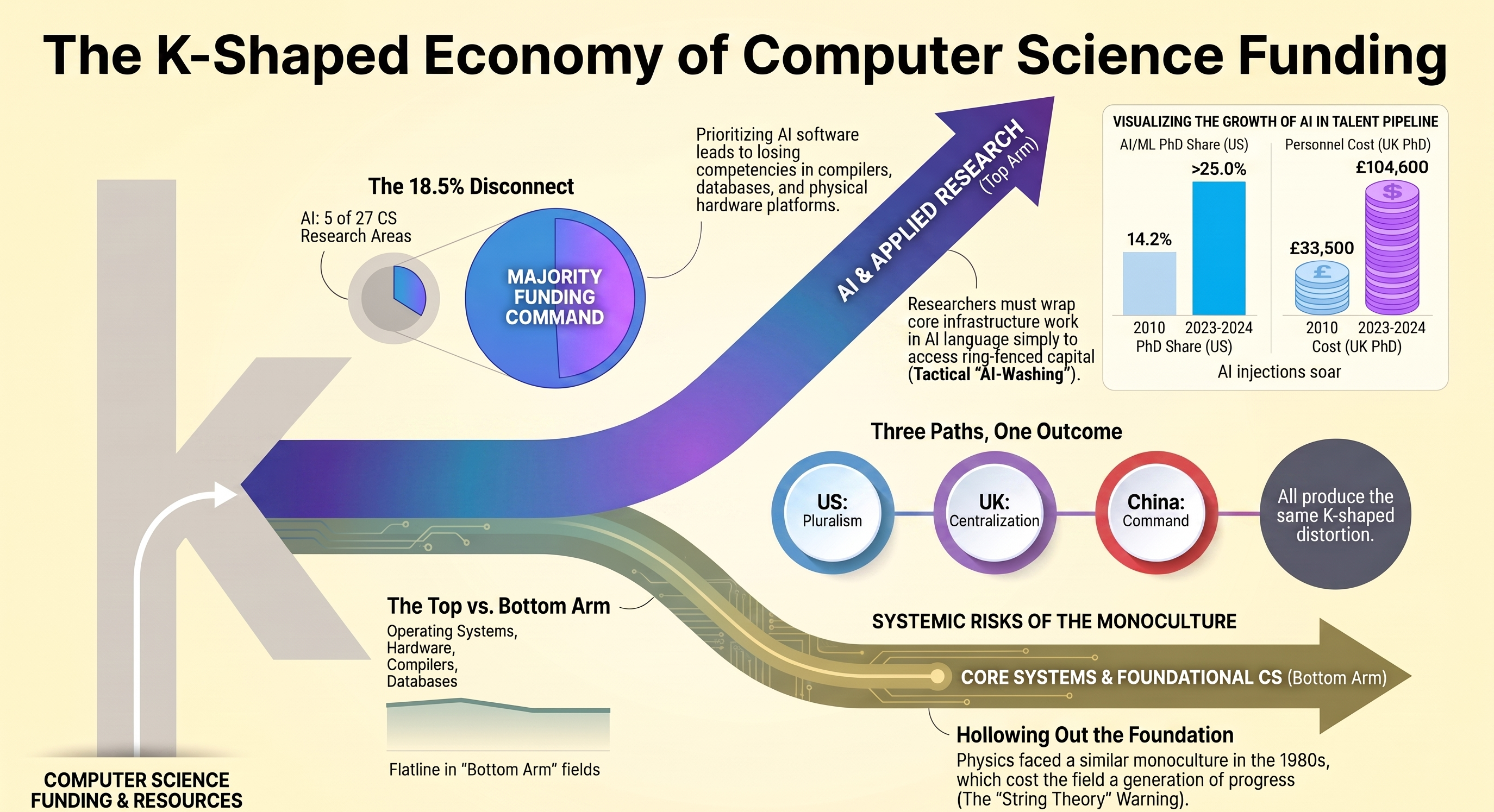
The mechanisms could not be more different — pluralism, centralization, command — and yet all three converge on the same K-shape as you see for AI technology companies: AI funding rising, with core systems capital flatlining or falling.
The real danger is not that systems research loses a single funding cycle and rebounds; it is extinction by attrition. Some academics will leave because of being de-facto defunded. Retiring faculty in operating systems, compilers, databases, and hardware architecture may go unreplaced because departments cannot justify a hire whose research portfolio doesn't touch AI.
A monoculture doesn't announce its arrival — it simply stops training the people who could have prevented it.
Four of the five theses examined here hold outright; the fifth holds directionally.
- Thesis 1 — that a global academic computing monoculture is emerging — is confirmed by the fact that three unrelated systems, pursued independently, arrived at the same result.
- Thesis 2 — that the K-shape has entrenched itself in permanent faculty hiring, not just grant cycles — is partially confirmed: the funding architecture structurally favors AI/ML tenure-track hiring over core computing, though the exact tilt isn't independently measured here.
- Thesis 3 — that researchers are gaming the AI premium in ways that mask the collapse — is confirmed by the gap between healthy-looking graduation statistics and the hollowed-out foundational pipeline underneath them.
- Thesis 4 — that AI funding suppresses the rest of CS — is confirmed most starkly in the UK's ring-fenced allocations, cushioned only partially by the US's pluralistic agencies.
- Thesis 5 — that overheads choke PhD hiring in the UK relative to the US and China — is confirmed by the 80% fEC deficit against full US federal cost recovery and China's overhead-free direct labor-cost model.
The survivability question is whether pluralism can be rebuilt where centralization has taken hold, before the systems pipeline crosses from contraction into collapse.
None of this is new. Physics ran the same experiment with string theory: it got its warning in 2006, from an insider, in a book people actually read — and by Lee Smolin's own account, the hiring incentives underneath the criticism never budged. Physics had its warning and looked away.
Computer science doesn't have to.
References
- CSRankings.org. "Computer Science Rankings: Areas, Faculty Affiliations, and the AI / Systems / Theory / Interdisciplinary Taxonomy." Available at: csrankings.org
- Smolin, L. (2006). The Trouble with Physics: The Rise of String Theory, the Fall of a Science, and What Comes Next. Houghton Mifflin.
- Woit, P. (2006). Not Even Wrong: The Failure of String Theory and the Search for Unity in Physical Law. Basic Books.
- Wikipedia contributors. "AI Winter." Wikipedia, The Free Encyclopedia. Available at: en.wikipedia.org/wiki/AI_winter
- Northwestern Kellogg Innovation Institute. "AI Is Changing Who Wins Research Grants." Available at: niinstitute.kellogg.northwestern.edu
- Qian, Y., Wen, Z., Furnas, A. C., Bai, Y., Shao, E., & Wang, D. (2026). "The Rise of Large Language Models and the Direction and Impact of US Federal Research Funding." Forthcoming in PNAS. Available at: arxiv.org/abs/2601.15485
- Babic, Tihomir. "The AI Ponzi Scheme: Slap on a Chatbot, Raise Millions, Leave Engineers Holding the Bag." StrataScratch. Available at: stratascratch.com
- Computing Research Association. "Taulbee Survey, Table D4: Doctoral Degrees Awarded by Specialty Area." CRA, Washington, DC. Available at: cra.org/resources/taulbee-survey
- National Science Foundation, Directorate for Computer and Information Science and Engineering. "CISE Budgetary Allocation Ledgers, FY 2014 – FY 2023." NSF, Alexandria, VA. Available at: nsf.gov/about/budget
- National Science Foundation. "NSF Announces $100 Million Investment in National Artificial Intelligence Research Institutes Awards to Secure American Leadership in AI." Available at: nsf.gov/news
- Funding Landscape. "NSF Grants in 2026: $8.75 Billion Appropriated, 1,752 Grants Terminated by DOGE, and a New Merit Review Process." Available at: fundinglandscape.com
- Nature. "Exclusive: NSF Stops Awarding New Grants and Funding Existing Ones." Available at: nature.com
- Inside Higher Ed. "NSF Halts New Funding and Caps Indirect Rate Costs." Available at: insidehighered.com
- Crunchbase News. "6 Charts That Show The Big AI Funding Trends Of 2025." Available at: news.crunchbase.com
- Amazon Science. "Amazon Launches $68 Million AI PhD Fellowship Program." Available at: amazon.science
- Gofman, M., & Jin, Z. (2024). "Artificial Intelligence, Education, and Entrepreneurship." The Journal of Finance. Available at: onlinelibrary.wiley.com
- Glassdoor. "Machine Learning Researcher: Average Salary & Pay Trends 2026." Available at: glassdoor.com
- Levels.fyi. "Machine Learning Engineer Compensation Data." Available at: levels.fyi
- UW News, University of Washington. "$10 Million Gift from Charles and Lisa Simonyi Establishes AI@UW to Advance Artificial Intelligence and Emerging Technologies." Available at: washington.edu/news
- UC Irvine, Donald Bren School of Information & Computer Sciences. "Donation from SAP Establishes New UC Irvine Endowed Chair in Artificial Intelligence." Available at: ics.uci.edu
- Rochester Institute of Technology. "Donors Commit $24 Million to Advance AI Leadership, Faculty Excellence, and Student Success at RIT." Available at: rit.edu/news
- Georgetown University, Office of Advancement. "$13.7M Gift Establishes Endowed Computer Science Chair Focused on Artificial Intelligence." Available at: today.advancement.georgetown.edu
- USC Today, University of Southern California. "USC Launches Transformational AI Initiative with One of the Largest Gifts in University History." Available at: today.usc.edu
- Nietzel, M. T. (2026). "Alumni Couple Gives University Of Chicago $50 Million For AI Faculty." Forbes. Available at: forbes.com
- Office of Governor Kathy Hochul, New York State. "Governor Hochul Launches the Nation's First Independent AI Research Center at a Public University at the State University of New York at Binghamton." Available at: governor.ny.gov
- UK Research and Innovation, Engineering and Physical Sciences Research Council. "ICT Theme Grant Portfolio Dashboard and Strategic Financial Briefings." UKRI, Swindon. Available at: ukri.org
- HM Treasury. "Budget 2014." gov.uk. Available at: gov.uk/budget-2014
- UK Research and Innovation. "Strategic Priorities Fund: Wave 1 — AI for Science and Government." UKRI. Available at: ukri.org/epsrc
- UK Research and Innovation. "UKRI Strategy 2026 to 2031." Available at: ukri.org/publications
- Alan Turing Institute. "Annual Reports and Financial Statements, 2015–2024." Available at: turing.ac.uk/about-us/governance
- Advanced Research and Invention Agency. "Opportunity Spaces." ARIA. Available at: aria.org.uk/opportunity-spaces
- Advanced Research and Invention Agency. "Nature Computes Better: Scaling Compute." ARIA. Available at: aria.org.uk/opportunity-spaces/nature-computes-better
- Advanced Research and Invention Agency. "Trust Everything, Everywhere: Scaling Trust." ARIA. Available at: aria.org.uk/opportunity-spaces/trust-everything-everywhere
- Advanced Research and Invention Agency. "Mathematics for Safe AI: Safeguarded AI." ARIA. Available at: aria.org.uk/opportunity-spaces/mathematics-for-safe-ai
- Research Councils UK / UKRI. "Full Economic Costing (fEC) and the Transparent Approach to Costing (TRAC): Guidance for Research Proposals." Available at: ukri.org/manage-your-award
- Imperial College London. "Research Funding: fEC Rates and PGR Costing, 2026." Available at: imperial.ac.uk/costing-and-pricing
- Times Higher Education. "Universities Hit by Employer National Insurance Hike, Confirmed." Available at: timeshighereducation.com
- UK Research and Innovation. "UKRI Is Increasing PhD Stipends and Improving Student Support." Available at: ukri.org/news
- Wonkhe. "What's Driving Low Levels of Full Economic Cost Recovery in Research?" Available at: wonkhe.com
- Wonkhe. "University Funding Is Driving the Research Funding Deficit." Available at: wonkhe.com
- Times Higher Education. "University Research Shortfall Rises to Over £5 Billion in England." Available at: timeshighereducation.com
- Times Higher Education. "As Cross-Subsidisation Falters, the UK Must Rethink Research Funding." Available at: timeshighereducation.com
- Research Professional News. "Cash Loss on Research Deepens to £6bn Across UK Universities." Available at: researchprofessionalnews.com
- Innovation Research Caucus. "Understanding Low Levels of FEC Cost Recovery on UKRI Grants." Available at: ircaucus.ac.uk
- Office of Management and Budget. "Uniform Administrative Requirements, Cost Principles, and Audit Requirements for Federal Awards (Uniform Guidance, 2 CFR Part 200)." Available at: ecfr.gov/2-CFR-200
- Carnegie Mellon University, Office of Sponsored Programs. "Federally Negotiated F&A Rate Agreement, 2026." Available at: cmu.edu
- People's Republic of China, State Council. "New Generation Artificial Intelligence Development Plan" (新一代人工智能发展规划), 2017. Available at: gov.cn
- Ministry of Education of the People's Republic of China. "First-Class Disciplines Classification and Catalogue." Available at: moe.gov.cn
- China National Knowledge Infrastructure. "China Doctoral Dissertations Full-Text Database (CDFD)." Available at: cnki.net
- AcademicJobs.com. "Professor Salary in China 2026: Averages, Ranks & Comparisons." Available at: academicjobs.com
- TeamedUp China. "The State of AI Jobs, Careers, and Salaries in China (2025)." Available at: teamedupchina.com
- National Bureau of Statistics of China. "Average Annual Wages of Employed Persons in Urban Non-Private and Private Units, 2025." Available at: stats.gov.cn
- WorldSalaries.com. "Average Software Engineer Salary in China for 2026." Available at: worldsalaries.com
- CNN. "In the Race to Attract the World's Smartest Minds, China Is Gaining on the US." Available at: cnn.com
- South China Morning Post. "China's Tech Giants Offer Lavish Year-End Bonuses Amid AI Talent War." Available at: scmp.com
- Center for Strategic and International Studies. "China's Localization Drive in Semiconductors Gains Impetus from Allied Chip Export Controls." Available at: csis.org
- 36Kr. "The Talent War in AI: Fresh PhD Graduates Offered Annual Salaries of 5 Million Yuan." Available at: eu.36kr.com
- National Natural Science Foundation of China. Official portal and project guidelines. Available at: nsfc.gov.cn
- National Natural Science Foundation of China. Science Fund Information System — project records. Available at: grants.nsfc.gov.cn
- National Natural Science Foundation of China. "Generative AI Basic Research" special program directive. Available at: nsfc.gov.cn
- National Natural Science Foundation of China. "AI-Enabled Engineering Science" special program directive. Available at: nsfc.gov.cn
- Zhang, H., Cao, Z., Huang, Y., & Zhang, L. (2025). "How China and the United States Fund Artificial Intelligence? Multi-dimensional Characteristics Analysis from the Lifecycle Perspective." Proceedings of ISSI 2025. Available at: issi2025.iiap.sci.am